One of my ‘other duties as assigned’ this time of year involves serving as The Christmas tree Guy and responding to various media inquiries about Christmas trees. Last week I posted a link to a media story about Christmas trees on the Garden Professor Facebook page. That post drew a response from Kyle Fletcher Baker who derided cut Christmas trees as “murder of the innocent.” My initial reaction was, “Jeez, Kyle we’re talking about fir trees here not lamb chops or veal.”… Continue reading this article “Silence of the lamb chops”
Tag: woody

My favorite on-line conifer resources
Posted by Bert Cregg
I just wrapped up putting together a species profile on grand fir (Abies grandis) for Great Lakes Christmas Tree Journal, which is the professional trade publication of the Michigan Christmas Tree Association. I do a lot of articles and presentations on conifers and while I draw on my personal experience and background as much as possible, invariably I’ll need to consult some references. Here are some resources that may come in handy if you need to develop a presentation or article or just want to know more about conifers.… Continue reading this article “My favorite on-line conifer resources”
Going off half-cocked
The good news about being a landscape extension specialist is you get to comment on a variety of landscape tree problems. The bad news? You get to comment on a variety of landscape tree problems. In an average week I probably get 10-15 tree-related calls or e-mails from homeowners, landscapers, growers, extension educators, lawyers, newspapers, and on and on. Sometimes the problem is routine and obvious like tar spot on maples; “I have these spots that look like tar on my maple leaves…” Sometimes the problem looks routine and turns into something else entirely different like the Imprelis herbicide debacle. … Continue reading this article “Going off half-cocked”
Random acts of horticultural violence
I’ve been traveling in Europe the past few days working on a project with some colleagues in the Czech Republic. While we typically think of our friends in Europe as being more progressive and cultured than us, it appears there are still a few areas where they have a ways to go – such as banning smoking from restaurants and bars – and in learning about the art and science of Arboriculture. (And before the hate mail from Europe starts pouring in; yes, I realize we can find plenty of scenes like this in the US – just hoped I’d find better on this side of the pond).… Continue reading this article “Random acts of horticultural violence”
Spring fever: Conifer style
We finally got a reprieve from our wet, cold weather. Just in time for the annual inspection of the conifer troops at the Harper Collection of Dwarf and Unusual Conifers at MSU’s Hidden Lake Gardens. One of the interesting things about making repeated trips to a conifer collection like this is that different conifers stand out each time. Whether due to lighting, background foliage, your mood, whatever; it seems like there are different stars each time.… Continue reading this article “Spring fever: Conifer style”
Living with lichens
We often hear that the US needs to boost its investment in science education to keep up with rest of the world. While we often think in terms of physics and chemistry when we think of science, we need to remember biology and ecology fit in the mix, too.
I bring this up because of a call a received a while back from a homeowner. The gentleman was concerned /borderline distraught that he would have to remove a prized maple tree from his front yard because it had “peculiar growths all over the trunk”. … Continue reading this article “Living with lichens”
Selection and Protection: Preventing the heartbreak of splayage
We’ve had considerable discussion over on the FaceBook site concerning snow damage to columnar arborvitae. This is a common phenomenon resulting in a condition Holly has dubbed ‘splayage’.
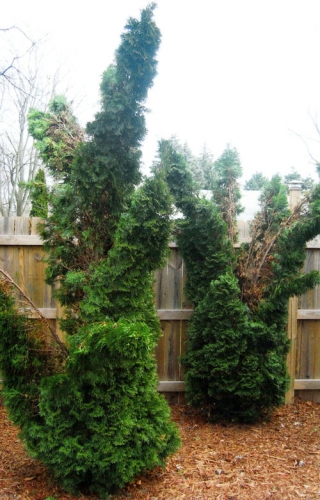
The question, of course, is what to do about it? My standard response to addressing most problems related to winter injury is there are two options: selection and protection.
Selection means putting the right plant in the right place. For columnar arbs this means not planting them in areas prone to wet heavy snow. … Continue reading this article “Selection and Protection: Preventing the heartbreak of splayage”
Where did the 10-20-30 rule come from? Is it adequate?
We’ve been having an interesting discussion over on the Urban Forestry group on LinkedIn on the origins and suitability of the 10-20-30 rule for tree diversity in urban forests. For those that aren’t familiar, the 10-20-30 rule is a guideline to reduce the risk of catastrophic tree loss due to pests. The rule suggests an urban tree population should include no more than 10% of any one species, 20% of any one genus, or 30% of any family.… Continue reading this article “Where did the 10-20-30 rule come from? Is it adequate?”
Buried alive – the roots version
Bert’s post yesterday inspired me to share one of my own timelines that I followed for 7 years. As many of you know, I am a proponent of bare-rooting container and B&B shrubs and trees. One of the benefits is that you can prune away malformed roots, but another is that you can ensure the roots come into contact with the native soil as soon as possible. It’s interesting to see what happens over time with the more typical “pop and drop” method.… Continue reading this article “Buried alive – the roots version”
A different kind of storm chaser
As an Extensional Specialist working on urban and community forestry issues, I am frequently asked to respond to questions about tree damage after storms. One standard bit of advice I give is to be wary of ‘door knockers’ or ‘storm chasers’; individuals that descend like locusts upon storm-ravaged areas with pick-up trucks and chainsaws offering to clean up storm damage. Sometimes these are just honest folks trying make a buck but there are also less scrupulous folks in the mix that are clearly exploiting the misfortune of others. … Continue reading this article “A different kind of storm chaser”