Why oh why? (Buried alive version)

Facebook

Sometimes when I’m stumped for ideas for blog posts, I get in my car and drive around my neighborhood.  Usually within 10 or 15 minutes I’ll see something stupid enough to write about.  Today was no exception. We live in a mostly rural area north of East Lansing but development is slowly but surely encroaching around us.  Part of that development includes a couple of golf courses.  One of the golf courses recently announced they were going to develop a high-end RV park adjacent to their course.  If you’re like me, ‘high-end’ and ‘RV park’ don’t sound like they belong together in the same sentence but I’ll take their word for it.  In any event, when the project was announced the developers placated local residents by noting they would install a large berm around the RV park to screen it off from two highly traveled roads next to the park.  Said berm was installed about a month ago.


Anyone see anything wrong with this picture?  There are about a dozen trees in similar straights.  Doesn’t give me much faith in the rest of this project…


I think the one on the right will be OK (it’s a telephone pole).  The one on the left, not so much…


“Quit yer bitchin’.  Ya wanted a berm, we built ya a dawgone berm!”


Facebook

Planting Edibles in Cities

Facebook

The snow has just started falling and I’m already thinking about what I’m going to be planting next spring.  Most of my plantings won’t be at my own house, they’ll be out in the cities of St. Paul and Minneapolis.  We’ll be looking at all kinds of fun stuff like growing trees in various new types of containers, adding compost to planting holes in different circumstances, and even pruning methods.  But one of the big things that we’re starting to look at are new trees for the urban environment.  Cities have always spent time considering what they plant, but with the emerald ash borer ravaging the Midwest, now they’re thinking even harder.  And because of the local food movement, suddenly the cities are at least considering trees like apples and hazelnuts on a trial basis (sure, there are some places that use them here and there, but they’re less than common).  Of course, if this movement stalls, the cities would be upset at having so many “messy” plants around (that’s their big concern about edibles right now), but I don’t think it will.  I’m actually pretty optimistic about using fruits and nuts on public property.  Sure, some plants will fail because they get too many diseases or insects, or because they’re weak wooded, but some will make it too.  I think hazelnut has a great chance in the right place (it would be too bushy for most boulevards….).  Do any of you have a favorite edible that you think might work well in a city?  Let me know, maybe we’ll try it!

Facebook

Closing the loop

Facebook

Just a short post today as I am participating in an Extension planning meeting for most of the day.  One up-side to the meeting is we are meeting and having lunch at Brody Dining hall here at MSU.  If you’re around my age and attended college in the 80’s, the thought of eating at a dormitory dining hall might elicit memories of a hair-netted cafeteria lady glopping amorphous slop on your tray next to the mystery meat of the day.  Boy, how times have changed.  Today, the quality of dining hall food is point of competition for universities angling for students.  The Brody dining center is set up like a food court, daily choices for students include a fresh salad bar, southwest food, sushi, made to order pizza, home-style comfort food, even kosher food.

The dining halls are also part of MSU’s sustainability initiative.  Food wastes from the dining halls are collected and sent to an anaerobic digester and composted at the MSU Student Organic Farm.  The compost is used at the recently completed Bailey hoop-houses on campus to produce salad green and herbs for use in the dining halls, providing a closed-loop system.  Is the food produced in the hoop-houses going to make the dining halls completely self-sufficient?  Probably not in the foreseeable future.  But they do provide a good opportunity to promote horticulture.  The project has generated numerous press articles and there are posters around the dining hall highlighting the project.  In an age when many bemoan the public’s disconnect between farm and fork, the Bailey GREENhouses remind students, especially those that might not think about it otherwise, where their food comes from.

Facebook

The eternal [gardening] optimist

Facebook

I’ve gotten better, actually.  After slaying hundreds of dollars worth of mail-order and/or inappropriate plants, I’ve learned to curb my urges a bit.

But not this time.

I was overcome by a sale at “Annies Annuals and Perennials” –  the most decadent, irresistible, West Coast, Zone 9 catalog ever.

Behold! The impossible-to-grow and majestic Puya*
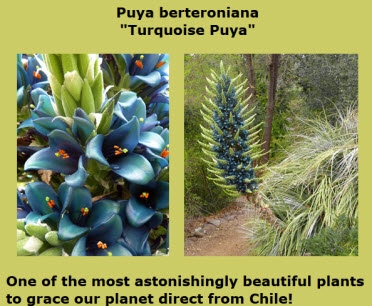
Mine! Mine! Mine!
It will reside in my greenhouse over the winter.
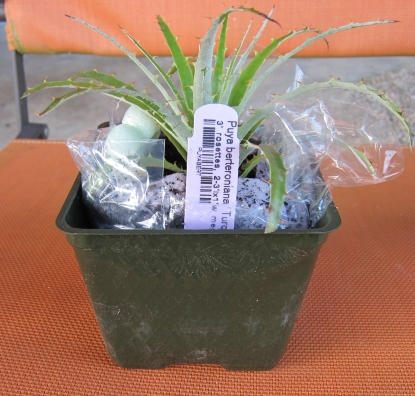

Packing peanut left in pot for scale.

Now taking bets as to how many years ’till bloom. Side action on years/months until I kill it.

*Can one of you familiar with the genus inform me as to pronunciation? I’m pretty sure my current “rhymes with booyah” isn’t it.


Facebook

The secret of immortality

Facebook

Last Sunday’s New York Times had a story about immortal jellyfish.  It was interesting, and given my previous life as a marine biologist, it was also a topic that was comfortably familiar. But really, I wasn’t that impressed.  Because plants do the same thing, yet no one bats an eye.

Gardeners and other plant aficionados have exploited the plant kingdom’s ability to remain forever young.  How many of us have taken cuttings of mature plants, rooted them, and started new ones?  I have a couple of miniature African violets whose leaves I can place on damp soil in pots, cover, and ignore.  New plantlets emerge from the base within a few weeks. I pot these up and give them away as gifts, but always keep a few for later propagation.

Some of the horticultural oddities we love exist because of plant immortality.  The Camperdown elm (Ulmus glabra ‘Camperdownii’) has been perpetuated for almost 200 years from a single original cutting from a tree in Scotland.  Particularly pernicious weeds do this on their own thanks to runners and rhizomes. Sure, we call it “vegetative propagation,” but really, it’s plant immortality.

So you’ll have to forgive me for not getting all torqued about immortal jellyfish.  I’ve seen immortality, and it’s growing in my garden.

Facebook

Does fertilization increase insect herbivores?

Facebook

Always fun when you find a research paper that confirms what you’ve suspected all along.  I ran across a paper last week in the Annals of Applied Biology entitled  ‘Fertilisers and insect herbivores: a meta-analysis’ (Butler et al. 2012. Ann Appl Biol 161:  223–233).  I’m interested in the topic because in recent years a dogma has emerged that if you fertilize a landscape tree it will be immediately devoured by insects.   In this study the authors conducted a meta-analysis (basically a compilation of studies on a given topic and then combining and analyzing the aggregated results) and looked at dozens of studies of the response of insect herbivores to fertilization to answer the question, does fertilization increase insect damage?  The answer was absolutely no surprise to me: It depends.


What does it depend on? First, what type of insect.  Secondly, what kind of fertilizer. For example, fertilizing with nitrogen greatly increases populations of sucking insects.  This makes sense when you stop to think that aphids and other sucking insects have to consume a lot of phloem sap –which is essentially sugar water – in order to get sufficient nutrients.  Nitrogen fertilization did not significantly increase populations of chewing insects, however.  This could be related to off-setting effects of improved nutritional quality of leaves versus increased presence of defense compounds or leaf toughness.  For  other fertilizer elements Butler et al. found that phosphorus decreased insect populations in 2/3rd of the studies (14 out of 21) and that potassium decreased insects in 7 out of 10 cases. As with nitrogen only, complete fertilizers (NPK) tended to increase insect populations, especially for sucking insects.


I should hasten to point out some limitations of the study as it relates to tree fertilization.  First, of course, is the British spelling of fertilizer. Second, the study mainly dealt with fertilization in agronomic crops, not trees.  Lastly, the authors only included studies on insect adults.  In many cases insect larvae, not adults, are the most damaging life stage, especially for insects that affect trees.  Nevertheless, the study highlights the difficulty of making generalizations when discussing host stress and insect interactions.  In addition to type of insect and type of fertilizer, we could have added nutritional status of the plant before fertilization to the ‘It depends’ list.  My rule of thumb is that trees shouldn’t be fertilized unless a problems is noted by visible symptoms, a soil test, and/or a foliar test – and preferably by more than one of these.


Bottom line: Before you buy into the notion that fertilizing a tree is going to increase insect problems make sure you know what type of pest you’re dealing with, what type of fertilizer and the current nutrient status of the tree.

Facebook

How Can Natives and Exotics Possibly Coexist?

Facebook

Natives vs. exotics. We’ve heard that before haven’t we Bert?  Well, here’s an interesting little nugget published recently in the journal Ecology Letters.  Exotics and natives are different, and their differences allow them to coexist.  In this study exotics were superior to natives in terms of growth, but were fed upon more by herbivores.  Interesting.   Of course there are lots of different types of exotics and natives, but the plants that these researchers looked at had been living together for about 200 years.  I think that’s something that the invasive extremists and apologists consistently forget – until relatively recently the average person didn’t spend that much time thinking about native or exotic, and yet the world never turned into a desert and neither the natives nor the exotics disappeared.  I’m not saying we shouldn’t think about native vs. exotic differences at all, just that sometimes we concentrate on this distinction too much. Plants tend to be able to fend for themselves.

Facebook

Ornamental Peppers for the Holidays (!)

Facebook

Growers and garden centers are always on the lookout for Poinsettia alternatives.  Points make up the vast majority of potted flowering plants sold this time of year, but other crops are gaining ground. Due in part to the popularity of All-American Selection (AAS) winner ‘Black Pearl,’ there’s been an explosion of ornamental pepper varieties.   Most are pretty versatile – can be used as bedding plant, in containers, and as a potted flowering plant.  Edible? Depends on your threshold for pain.

I took these photos during an August visit to the immense trial gardens of Rakers (Litchfield MI).  They had at least 30 varieties of ornamental pepper, and many look very similar.  Hopefully I’ve got these labeled correctly…


‘NuMex Twilight’, bred by the folks at the Chile Pepper Institute at New Mexico State, has been around for a while. There were lots of look-alike cultivars in the trial.  But they all resemble Christmas lights!


 ‘Sangria’ peppers start purple then ripen bright red. 


I believe this one is ‘Pretty in Purple.’ 

I think any of these would be very gift-able for the holidays. Dressed up with a nice 5" clay pot and a raffia bow…would you buy an ornamental pepper for decor or a gift?

Facebook

A holiday gift idea

Facebook

In deference to the holiday season, I’ll step down temporarily from my soapbox and mention a great holiday gift idea for your favorite gardener.

I saw this sedum stump a few years ago when I was speaking to a Master Gardener group in British Columbia.  The porous nature of the stump would make it easy for the roots of the sedums and other rock-garden types of plants to establish. And the stump could be easily moved to wherever the recipient desired.

This isn’t just a warm climate idea, either.  There are a number of sedum species that are cold hardy and as long as the stump was well protected in the winter, the roots would be fine.

Facebook

Why oh Why? Christmas tree edition

Facebook

Hope everyone has had a chance to digest their Thanksgiving meal and is spending a productive day at work shopping on-line.  My daughter and I enjoyed one of our Holiday traditions this weekend and brought home a Christmas tree from a local choose-and-cut farm.  This was followed by another tradition at our house known as the “Annual cursing of the Christmas lights.”  Seems like no matter how careful I am when I put away the lights when we take down the tree, they are always a mangled mess the next year.

Christmastime is also time for another ‘Why oh why?’  As in, why do people make such a big deal out of watering their tree?  Working in Extension with Christmas trees, I’m glad that we’ve gotten the word out and people are concerned with keeping their tree watered.  But is it really that hard to put water in the stand?  I use a watering can with a long stem and it seems to work fine.  Let’s look at some of the devices people have come up with water Christmas trees.  I’ve rated each on scale of 0 to 4 watering cans.


The tree IV.  I’ve mentioned this one on the blog before.  The theory here is that the tree will suck up water from a reservoir you attach to the trunk.  Trunk injection is possible with conifers but requires pressure and resin quickly fills the hole. 0 cans.


The watering cane.  OK, maybe you’ve got back problems and bending over with a regular watering can could be an issue. 4 cans.


Water funnel system.  I’m not sure the video convinced me this is faster and easier than the watering can. 2 cans.

Water reservoir cleverly disguised as a package.  Assuming the issue is you don’t like to bend over and put water in the stand, I don’t see where bending over to put water in a fake package is a big improvement.  And what happens if you forget which package is which? 2 cans.


Funnel cleverly disguised as an ornament.  Gets around the bending over issue, but can you really hide the tubing? 3 cans.


Christmas Vacation anti-transpirant.  According to the advertisement you can put this stuff in the first time you water the tree and then you are good to go for the next month.  The same product is sold as ‘Stasis’ and is used to protect bedding plants from wilting during shipping.  The theory is that the product induces stomatal closure by increasing abscisic acid levels.  I’m withholding judgment on this one until I see some data one way or the other, but to say I’m dubious is an understatement.


Keeping a Christmas tree hydrated is like most things; you can’t go wrong with the tried and true.  A fresh tree that is kept well-watered will retain needles for weeks and is very unlikely to be involved in a tree fire.   A tree this is allowed to dry, on other hand, is another story.  So before depending on a gimmick to keep your tree watered ask yourself if you’re willing to bet your house on it.


Facebook