A bit more on my recent travels to the big floriculture conference in Columbus, Ohio. I always try to make it out to the Chadwick Arboretum & Learning Gardens, on the campus of THE Ohio State University. There are several components, including trials, a large arboretum, and several small gardens. My favorite is the Steven Still Perennial Garden. It’s a lovely mixed garden, designed by Adrian Bloom (Blooms of Bressingham), and was installed in ONE DAY by their garden volunteers – 2005, I think.… Continue reading this article “Lamb’s Ears Revisited”
Category: Perennials and Annuals
What’s New?!
Just back from OFA – my discipline’s humongous tradeshow and conference in Columbus, Ohio. All things Floriculture – new perennials, annuals, and seasonal plants, technology, structures, and equipment for greenhouses, and plants and products for floral designers. The bulk of the show and educational sessions is focused on growers, but garden center owners and florists are also targeted. I was part of two team talks for growers on “Perennial Production Problems and Solutions”.
Aside from the thousands of attendees and hundreds of exhibitors, it’s like a big family reunion for floriculture faculty involved in teaching, research, and Extension.… Continue reading this article “What’s New?!”
The Other Lamb’s Ears
I’m assuming even you tree people (aka other
Garden Professors) are familiar with the soft, silvery leaves of Stachys
byzantina or Lamb’s Ear (variously Lamb Ears and Lamb’s Ears). Not to
disparage S. byzantina, but in our part of the world it looks like a
pile of wet dryer lint in the winter; and can become similarly
disfigured during a hot, wet summer. Spring brings bright,
pet-able new ears, followed by woolly flower spikes that could serve as
Q-tips for Shrek.… Continue reading this article “The Other Lamb’s Ears”
Beantroversy
Castor Bean – Ricinis communis. Folks who make their living creating fabulous color displays for public gardens, municipalities, and commercial parks love ‘em. Civilian gardeners/plant geeks love ‘em. People who get their knickers in a twist about poisonous plants do not.
Pros: ridiculously rapid growth, huge leaves for that tropical look, tolerant of less-than-ideal conditions, cheap and easy to grow from seed, weird wild flowers and seed pods.
Cons: pretty darn poisonous. A few seeds (have seen figures from four to 20), chewed up to release the toxic protein ricin, will allegedly kill you.… Continue reading this article “Beantroversy”
Building a Better Container, Part Deux: The Ellepot
I enjoyed Jeff’s post on the RootTrapper and thought I’d share another interesting and [relatively] new development in the world of greenhouse growing containers.
Take a tube full of growing media, wrap a paper sleeve around it, and voila – the Ellepot!
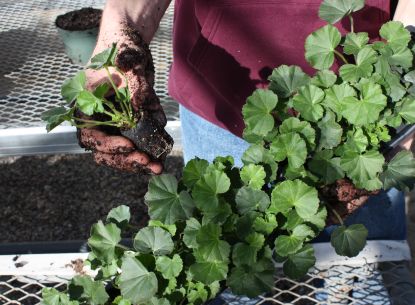
It’s bottomless, root permeable, and degradable. Each Ellepot sits in its own cell in a re-usable tray. The great aeration and drainage makes for a happy, healthy root system. Another plus is that after transplanting, there are no pots or packs to throw away
I’d say the bulk of Elle Pots are utilized at the propagation end of things – starting seeds and rooting vegetative cuttings – either for greenhouses to “grow on” themselves or as plug/liner products sold to finishing growers (see student Paul Hutcheson holding a geranium liner above).… Continue reading this article “Building a Better Container, Part Deux: The Ellepot”
Last-Frost-Date Roulette
We all play the game – at least the more impetuous among us do. You sneak a few tender things out into the garden, or on to the patio. When the temperature drops and there’s a frost warning, no problem…just cover them up or bring them in.
Unless you forget.
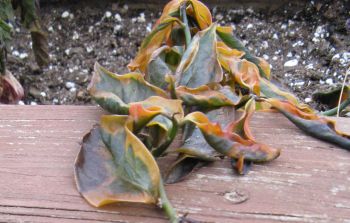
This WAS a rare and neato Pereskia aculeata ‘Variegata’. Paul W., please send me another…
Before dawn on Monday morning, (May 9) the temperature on our little mountainside dropped below freezing for four hours, going as low as 29.5 F according to our weather station. … Continue reading this article “Last-Frost-Date Roulette”
Visiting Professor guest post: Native wildflowers
Recently I have been fascinated by the native wildflower field I planted last fall. Although I seeded it with the same mixture of seeds (mixed with sand to spread them evenly), you can see that we have clumps of different flowers throughout the area.
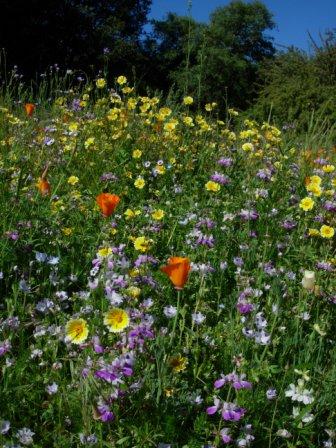
Figure 1. Descanso Gardens, California
The area where the wildflowers were planted had several 1-2 foot raised mounds; some were in the shape of keyholes. These were built with silty sand from a nearby seasonal stream that had some erosion problems in a rainy year.… Continue reading this article “Visiting Professor guest post: Native wildflowers”
Surviving the desert with beauty and efficiency
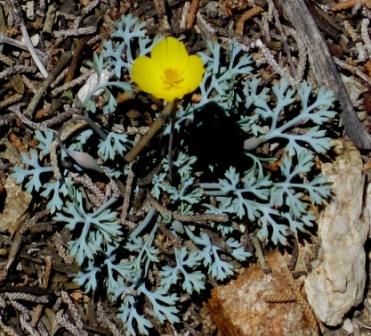
I’m away this week for an out-of-state seminar and a little annual leave. Some of my favorite places to visit this time of year are the high deserts of California. Today we hiked to Horse Thief Creek, a relatively easy trail in the Santa Rosa Wilderness. It’s the perfect time of year to see the high desert in bloom, especially with last winter’s substantial rainfall.
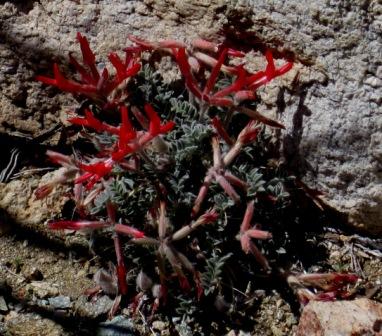
In graduate school I became interested in environmental stress physiology, and I still am entranced by the plant kingdom’s ability to overcome nearly every environmental extreme on earth. … Continue reading this article “Surviving the desert with beauty and efficiency”
Baffling Daffs
It is daffodil season in the Northern Hemisphere, hurrah! May their blooms shoo away the gray of winter! It is also the season where everybody and their mother writes something about the wonders of the genus Narcissus, so figured I’d join the fray, but with a bit of a chip on my shoulder…

Miss ‘Barrett Browning’ in the Hahn Horticulture Garden at Virginia Tech
I recently read YET ANOTHER article warning against mixing daffodil stems in with other cut flowers due to “harmful effects from the sap”.… Continue reading this article “Baffling Daffs”
I’m Saving Myself for Pollination
Let’s take a very brief respite from the socio-religious implications of science, soil testing, and compost tea to ponder a more lighthearted topic. I need a bit of a morale-boost.
You: “O.K. Holly, Spring’s allegedly coming…how about a closer look at some wildflowers?”
Me: “Done!” (fingers snapping)
For a short time in March, forest floors across Eastern North America can be absolutely littered with a multitude of sparkling white flowers. This very cool little plant, Sanguinaria canadensis, is one of the first wildflowers to emerge in the spring and colonizes deciduous and mixed woodlands.… Continue reading this article “I’m Saving Myself for Pollination”