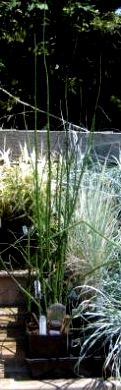
Why bother having trees?

Sorry to be late with my post this week – I was away reviewing grant proposals.  It was interesting and useful work, but really drains your brain.  So with that being said, my post is long on pictures and short on words.

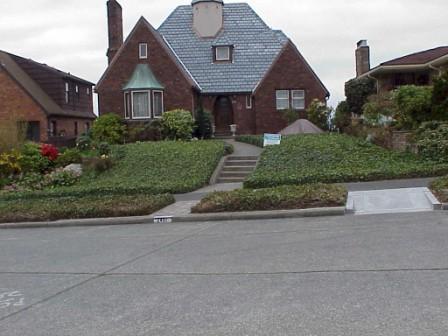
One of the things that bugs us GP types is poor plant placement.  Why bother planting a tree if you’re not going to allow it to grow naturally?  Here are some photos to mull over the weekend. … Continue reading this article “Why bother having trees?”
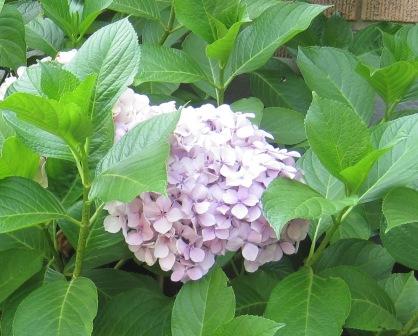
Hues of hydrangeas

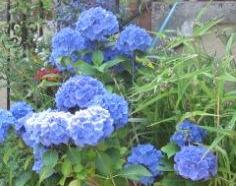
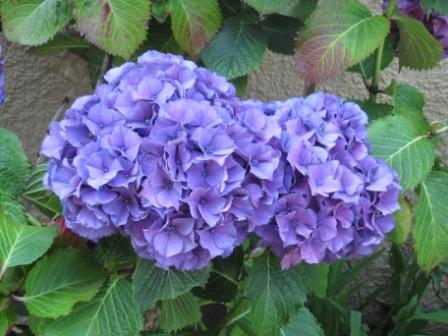
Hydrangeas are in full bloom this time of year.  I snapped these photos yesterday of several hydrangeas, all planted along the same strip of land.  Just look at the different colors:

Why so many colors? Most of you probably know that genetics play a role, as does soil pH.  But there’s much more to it than simple soil chemistry and genes.

1. pH:  Strongly acidic soils produce blue hydrangeas, while slightly acid to slightly alkaline soils favor pink or red flowers.  … Continue reading this article “Hues of hydrangeas”

Where to draw the line on a vine

Last week’s column on “why do nurseries sell this plant?” struck a chord with many readers as well as with Holly!  So here is this week’s submission:  that ubiquitous vine, English ivy.

First of all, we’ll stipulate than many ivies are sold as English ivy (Hedera helix) but may be entirely different species.  Genetic research on invasive ivy populations in the Pacific Northwest identify most as H. hibernica (aka Atlantic ivy), with H. helix making up only 15% of the invading populations. … Continue reading this article “Where to draw the line on a vine”

Clematis calamity solved

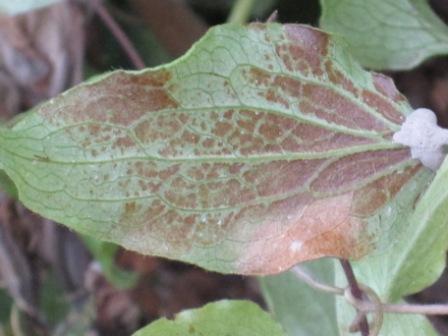
Some good and creative guesses about why the Clematis leaves had interveinal necrosis.  While iron and manganese deficiencies both cause interveinal chlorosis (veins are green, areas between are yellow), the necrosis indicates tissue death between the still-living and green veins.  Very simply, this has been caused by water loss.

During transplanting of the vine, I had to remove them from the fence and lay them out on the ground.  They remained this way for a couple of days. … Continue reading this article “Clematis calamity solved”

Friday quiz – yet more clematis calamity!

If you’ve been following the saga of our clematis, you’ll know that first they suffered iron toxicity (from the waterlogged soil they were in) and then were dug up and replanted in containers.  Last week I showed you what happens when you vigorously work wet soil – yet more waterlogging!  During the transplanting process, I took more pictures:

This damage is NOT from the iron toxicity problem.  It appeared during the transplant process.  What caused it?… Continue reading this article “Friday quiz – yet more clematis calamity!”

Why do nurseries sell this plant?

I wish I were more like Holly…wandering around nurseries finding pretty and unusual annuals and perennials to get excited about.  Instead, I seem to gravitate to plants that annoy me.

Today while looking for some trellises (for those containerized Clematis vines that I’ve been torturing) I saw pots of the Equisetum hyemale (“a tall, evergreen, spreading, reed-like grass”) for sale:


As readers of this blog surely know, Equisetum spp. – or horsetails – are not grasses but primitive relatives of ferns. … Continue reading this article “Why do nurseries sell this plant?”

Clematis conundrum clarified

Friday’s puzzle was tricky!  I will preface the answer by saying I don’t do a lot of container plants except for annuals.  When I plant up annuals into soilless potting mix (which is dehydrated), I work in the water thoroughly into this fluffy medium.  Friday’s situation was a little different.  The Clematis are more or less permanent residents in these planters, so I use real soil rather than potting mix.  (This will reduce or eliminate the shrinkage you’ll get if you use soilless media, as these highly organic materials steadily decompose.)… Continue reading this article “Clematis conundrum clarified”

Friday quiz – the tale of two clematis continues

A few weeks ago I showed you photos of iron toxicity in a Clematis planted in a soggy soil (perched water table).  Because this area is just not conducive to plants, we’re putting in a small deck.  This necessitated the excavation of two Clematis, which were both suffering from wet feet.  (Needless to say the root mass was very small and shallow on both plants.)  We decided to put them into large planters with conical trellises and use them as deck plants.… Continue reading this article “Friday quiz – the tale of two clematis continues”

Restoration ecologists – you need us!

Restoration ecology – the science of restoring degraded ecosystems – is another branch of applied plant sciences.  Oddly enough, very little plant science makes it into the scientific literature of this field.  This has driven me nuts for a number of years after reading an endless stream of papers where no mention is made of how plants are selected, installed, and managed.  Or worse, some ancient horticultural practices are used – like amending the backfill with organic material rather than using just the native soil. … Continue reading this article “Restoration ecologists – you need us!”

Tomato takedown

Well, Dr. Rohwer was right – he thought you’d get this more easily than I did!  Ray and Jon were spot on – this is classic juglone toxicity from those walnut trees (Juglans spp.) you see in the background.  Many of these leaves ended up on the roof, leaching into the rain barrels (good sleuthing Ray and KennyG!), the water in which was used in irrigating the vegetable garden.  In fact, Dr. Rohwer divulged that the rain barrel water was quite brown from the walnut leaves. … Continue reading this article “Tomato takedown”