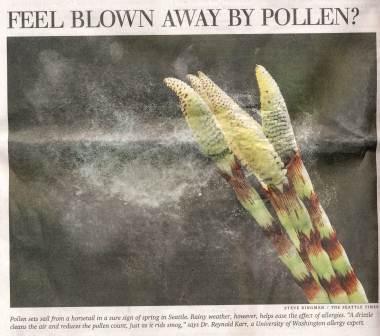
My sharp-eyed husband spotted this on the front page of yesterday’s paper:
Answer Monday!
Rotenone is an organic insecticide that has been voluntarily withdrawn by its manufacturer because it’s quite toxic, it’s dangerous to the environment, and there is some evidence that it causes Parkinson’s disease. And there are safer choices. For my post today I was thinking of posting about all of the places I could still buy rotenone, but after doing a web search I couldn’t find many – and most of the places I found to purchase it don’t really have it (I don’t think) – they’re just old pages that weren’t taken down.
But in my string of results I kept getting this one weird hit – something called Goodwinol ointment for dogs. So I looked into it, and sure enough, there’s an ointment you can buy for your dog that contains 1.25 % Rotenone. It’s supposed to be for mange, but no prescription is necessary, so anyone could buy it. To me this is a little concerning. Rotenone is some nasty stuff, 1.25% is a relatively large dose, and I’m not sure that most people using it would be careful to use gloves. So I’m wondering, should this stuff really be out there?
With 60+ newbies in our local beginner beekeeping class, we can safely say that beekeeping is enjoying a surge of popularity. The president of our area beekeeping association is bringing 150 packages of bees up from Georgia next Thursday; all are pre-sold to members. That’s about 1.8 million honeybees (includes one queen per package). An additional 50 packages will arrive the following week for close to 3 million bees. Wow.
I’ve planned to take the afternoon off (Beefest!) from work to pick my two packages up and promptly introduce them to their new homes. The official term is to "install" a package but that sounds kind of clinical to me. One installs carpet and mufflers, not honeybees. Anyhoo, I’ll have six hives total!
I rarely remember to take my camera with me when working with the bees, but managed a couple of pics last week.

White tube socks serve a number of purposes. Pull them up over pant legs to keep wandering bees out (a very exciting situation indeed). Also, white’s good – bees seem much less concerned with light colors than dark (a good guideline in beekeeping apparel: try to not look like a bear). Bonus: they’re super sexy.

"Where did you get that pollen?" No, really, that’s what’s going on here. Check out the "Waggle Dance" video (perfectly safe for work).
Other possibility: "Does this pollen make my butt look big?"
It’s spring, and everyone is itching to buy stuff at the nursery. I’m there too, with my camera as well as my wallet. I thought you might enjoy some of my “Things to avoid when you are plant shopping” collection:

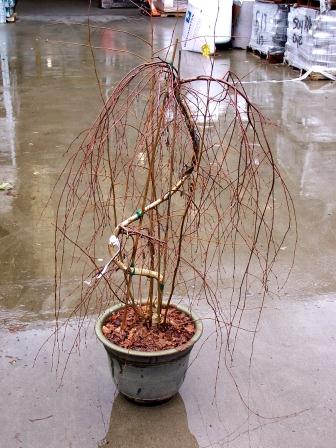
These are called “Serpentine.” I call them unnatural. Like foot-binding.
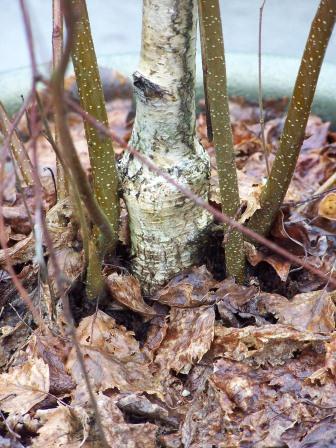
Rootstock revolt. The surest way to kill off your grafted scion.
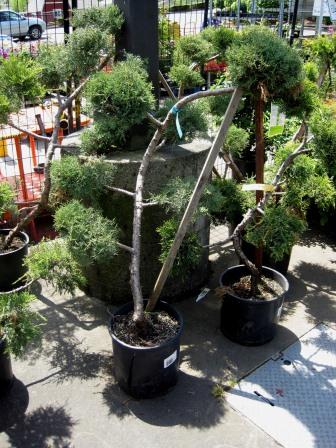
A botanical bow? Or a horticultural harp?
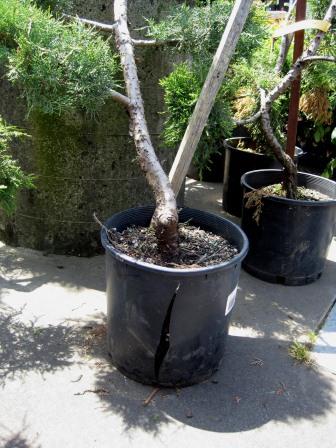
And check out the pot! If there’s enough root mass in there to crack the pot, you can bet it’s long past its potting up date.
Love broccoli? Then why not have a broccoli tree???
Looking for a maintenance nightmare? Then this beheaded beauty is for you!
Don’t ever unwrap this plant. It will immediately fall over and/or break. Just keep it as is – call it your turtleneck tree.
Despite Linda’s assertion to the contrary, I was not cow-tipping nor was I sampling micro-brews last week when I missed my regular post. As usual, the beginning of spring is a busy time on the research side of my appointment. This past week we began setting up for a major new project. The goal of our newest study is to look at physiological traits of street trees that may enable them to better withstand future climate change.
If you think about it, trees that are planted today may experience future climates in their lifetimes that will be different than the climates under which they were selected. So how do we ensure that trees that are planted today can withstand a potentially different environment in 50 or 75 years? It’s a very complex question. An easy response would be to plant species or seed sources that have evolved in warmer, southern locations. The problem is climate change is predicted to occur gradually so southern trees moved northward today will be subject to increased frost and freeze damage in the interim.

Grad student Dana Ellison (L) and undergrad research aide Aniko Gaal (R) pot up shade tree liners for a new project.
Another approach, and the one we are investigating, is that trees that are best suited for the future may be those that have a high degree of phenotypic plasticity. What is phenotypic plasticity? Simply stated is the relative ability of a species or genotype to acclimate to changes in their environment. In our case we are going to look at the photosynthetic response of a range of street tree cultivars in order to identify their optimum temperature for photosynthesis or Topt. But we know from other studies that Topt can vary depending on the environment to which trees are acclimated. So we will acclimate our trees to a range of temperatures in a greenhouse study and determine which species or cultivars are best able adjust their physiology to changing environmental conditions. In addition to the greenhouse study we will out-plant trees from the same cultivars in a parallel field study with the Greening of Detroit. Working with the Greening we will identify sites around Detroit with contrasting temperature regimes and plant trees at these locations. We will follow up with a similar suite of measurements as our greenhouse trial.

Will one study tell us everything we need to know about selecting street trees for a changing climate? Of course not. But it provides some important base line information and insights on approaching the problem. Trees in urban and community forests are already operating at the margins and subject to myriad of stresses. The argument can be made that urban ecosystems are among those most at risk under climate change. Trees are an important component of many climate change mitigation strategies but they must be able to survive and grow in order to contribute this function.
The study “Urban tree selection in a changing climate” is funded by Michigan State University Project GREEEN, with material and in-kind support from J. Frank Schmidt and Sons Nursery, Nursery Supplies, Inc., Renewed Earth, Inc., and the Greening of Detroit.
First, let me give a blanket apology for all of us GPs – this is the first time ever all four of us have NOT posted in the same week. I’m on the road this week with my high schooler checking out colleges, and I think the other three are out drinking beer and tipping cows somewhere. So our visiting GP veggie specialist extraordinaire has graciously stepped in to answer a reader’s question about the apparent decline in vegetable nutrition. Here’s Charlie:
Your United States Department of Agriculture tracks information about all kinds of things, like dry bean production and farm wage data. They also measure nutrient content of foods (not pesticide residues–that’s for the FDA). Some curious researchers have wondered if the nutritional content of vegetables has changed since the mid-20th century. The data exist, so why not look through them?
Authors of a well-cited publication from 2004 have done just that. Specifically, Davis, Epp, and Riordan did (J. Amer. College Nutr., 23:669-682). What they found, for example, is if you ate cauliflower in 1950, you probably ate more protein, phosphorous, iron, and thiamin than if you ate the same amount cauliflower in 1999. They measured the ratio of the nutritional concentration in 1999 compared to the concentration in 1950 [smartly, they adjusted 1950 moisture content to match that of 1999]. If ratio was 1, there was no difference in the concentration. If the ratio was 0.5, then 1999 cauliflower had half the nutrition of 1950 cauliflower. They had to use some statistical trickery (they didn’t know error or the number of samples from 1950), but some people might just call that ‘educated assumptions’. When these ‘educated assumptions’ must be made, I’m a big fan of being conservative with them–in this case, that means that if there is a tiny difference, the researchers wouldn’t catch it. Being conservative with statistics makes the differences that show up more robust. Even with the most conservative assessment, the authors show that 26% of the time when nutrients are studied in vegetables, the concentration was lower in 1999 than in 1950. However, 11% of the time, the concentration was higher in 1999.
The primary author of that paper published a summary of evidence in 1999 (HortScience 44:15-19). The average numbers for a bunch of studies show similar declines, but statistically, there seems to be a significant decline in specific nutrients in about ¼ to ⅓ of vegetables studied over time.

‘Jade Cross’ brussel sprouts
Why would this be happening? Well one reason might be dilution. The review article gave an example of raspberries: growing raspberries with more phosphorous fertilizer gave more yield (on a dry weight basis), and higher phosphorous concentration in the fruit. But the plants still took up the same amount of calcium (or only slightly more), irrespective of how many pounds of raspberries were produced. More pounds of raspberries with the same pounds of calcium removed from the soil means less calcium per pound of raspberries. That makes sense. The plants can make much of their own dry matter (photosynthesis!), but they can’t make calcium. I have some questions about using the dilution argument for the 2004 paper: if dry matter didn’t change, but concentration of macronutrients went down, the concentration of something else had to go up–but what? Is the decline in specific things large relative to the concentration of that thing but small relative to the total dry matter?

‘Graffitti’ cauliflower
The dilution effect may be the cause sometimes, but what causes the dilution effect? Atmospheric CO2, or changes in production practices like irrigation, pest control, and fertility might be important, but I like the ‘breeding’ explanation. Breeders don’t care how much calcium the plant has. They care if it yields well (dry matter), is resistant to pests and diseases, is pretty or unusual, tastes good, etc. If a trait is not selected for in a breeding program, it might go away over time. So maybe the answer is to breed veggies that accumulate (or make, if it’s a vitamin) more nutrients, or to grow more of the existing varieties that might, by chance, already have relatively high nutrient concentrations (they do exist). There may be a market for selling broccoli that has certifiably more calcium in it, and for change to happen in the marketplace, it has to be profitable. For right now, you have no idea if the broccoli you buy is a low-calcium or a high-calcium variety because consumers don’t demand to know.
The un-interesting headline reads “some vegetables may be declining in average nutrient concentrations over time”. The interesting (and false)
620
headline would be “vegetables aren’t good for you anymore”. From the cauliflower example above: in 1999, a serving of cauliflower would have about 2.5% of your recommended daily iron, 6.3% of your phosphorous, 3.5% of your protein, and 4.8% of your thiamine. In 1950, it would have been 6.1% of your iron, 10.3% of your phosphorous, 4.3% of your protein, and 9.2% of your thiamine. Your vegetables aren’t devoid of nutrition, they’re good for you. Easter candy probably has none of those things. If you’re worried, have a multivitamin, or better yet, eat MORE vegetables. But vegetables grown in 1950 are rather old by now, I’d avoid them if I were you. Meanwhile, know that a) science is aware of the issue, b) it’s not universal.
When my day/week/month is going to heck in a handbasket, when faced with yet another impending-doom deadline, when the pile of folders on my desk grows so tall I can barely see over it… when the going gets tough, a little bit of cute can go a loooong way.
So here ’tis:

Thalictrum thalictroides ‘Pink Pearl’
Not many plants fall into the "cute as a kitten/puppy/baby duck OMG" category, but this is one of them.
Used to be Anemonella thalictroides, but recent molecular "fingerprinting" puts it into the (rather redundant) genus Thalictrum. This April-blooming woodland native (eastern North America) usually has bright white flowers. ‘Pink Pearl’ is a marvelous pinky-lavender selection made by Dr. Jeanne Frett and the gang at the Mt. Cuba Center, Greenville, Delaware.
I took this photo at Mt. Cuba in 2008 and have waited impatiently for ‘Pink Pearl’ to appear in the trade ever since. If anyone has any info as to where to get one, do fill me in.
I like to say that my taste in music is eclectic, but it’s not really true. I like music that is known as classic rock (60s – 80s rock once known as pop) and I like music known as "alternative" (really a meaningless term — but I don’t invent the labels). The one band that I love who might be considered completely out of the mainstream is Rasputina — a cello based group who sing about many things, including history. 1816 in particular. Listen, it’s a history (and meteorology) lesson in a song.
So, that said, In 1816 there were freezes in every month of the year across much of the Northern part of the US. Leaves were frozen off trees almost as they formed — and yet, unless trees were small and/or weak, they lived to see 1817 (also a tough year), and beyond. Sure, fruit production was way down, but trees are prepared for tough conditions — they store plenty of carbohydrates to protect themselves against that very thing occurring. So, if anyone asks what’s going to happen to our trees if they flush out early (which they are doing) and then there are some late frosts, just point to 1816. Or, better yet, let them listen to the song.
A few weeks ago an attendee at one of my seminars asked me about bokashi composting. It’s a term I hadn’t heard before, so I promised to look into it (and the science behind it, of course). I haven’t had a chance to do much more than a cursory analysis, but even that has proven interesting.
For those of you who, like me, had never heard of bokashi, it’s a composting technique that utilizes Effective Microorganisms® as a way of creating a “positive” compost product using “positive” microorganisms. Unlike those found in aerated compost tea, these microbes are primarily anaerobic. They have been packaged and marketed for a number of applications, including water and sewage treatment. Since this is a gardening blog, I limited my search to journal articles on whole plant experiments.
I found almost 50 articles in my initial sweep through the literature – I pulled out articles that included the word “bokashi.” (There are many more [over 300] that mention “effective microorganisms” but it will take some time to winnow through those.) Without reading the abstracts of my collected articles, I separated them into three categories: top tier journals, lower tier journals, and meeting proceedings. Top tier journals are generally those that have been around for a long time, have an international distribution, and are considered to be rigorous in their peer review process. Lower tier journals may include those limited to a university or a single country, written in a language other than English, or relatively new; in many cases, this means that the peer-review may not be as rigorous as for top tier journals. This may be unfair, but it’s one of the ways that scientists consider the impact of published research. And finally, published meeting proceedings are almost always unreviewed.
(For those of you interested in how academics stress over journal ranking, you’ll be amused, depressed, and/or in total disbelief after reading this and this in the Chronicle of Higher Education.)
So here’s what I found when I read the abstracts of the articles in all three categories. Briefly, I noted whether or not the bokashi treatment (which generally included Effective Microorganisms®) was effective in disease control, improving crop yield, etc. I only read the abstracts, as many of the articles are not available as electronic resources.
Proceedings – no peer review (16)
Bokashi treatment better than whatever it’s compared to: 15
Bokashi treatment no different or worse than whatever it’s compared to: 1
Journal articles – lower tier resources (25)
Bokashi treatment better than whatever it’s compared to: 15
Bokashi treatment no different or worse than whatever it’s compared to: 7
Mixed results: 3
Journal articles – top tier resources (5)
Bokashi treatment no different or worse than whatever it’s compared to: 5
Quotes from abstracts of these last five articles:
“…did not improve yields and soil quality during 4 years of application in this field experiment.”
“We consider EM products to be ineffective.”
“…the chard treated with [EM products] lost considerable water and weight…the organic methods tested produce a vegetable that can not sustain its quality when commercialized through the conventional supply chain.”
“The treatments did not notably modify the physical and chemical quality of the chard when compared with control plants.”
“Overall, the results confirmed the…effect of compost application on plant growth. However, under the conditions of this study, EM showed no special effects in this.”
Interesting.
A few weeks ago I posted on the disappointing inclusion of compost tea in the APLD’s Guide to Sustainable Soils. Included in my discussion of the issue was the suggestion that people involved in writing the guide also benefited financially from compost tea applications. This led to some very honest and constructive emails between me and the APLD’s national leadership, which resulted in educating both parties.
Here’s what I found from the APLD’s President Susan Olinger and Sustainability Chair Toni Bailey: “As members of the Board of Directors of APLD, we can verify that there was no financial motive behind the inclusion of compost tea by the volunteers that wrote the soils guide.” This is heartening and makes me feel less cynical about the motives behind including compost tea in the publication.
And here’s what I was able to impart to the leadership of APLD: that while landscape designers may like to include compost tea as a soil amendment, the belief in its efficacy in improving soil tilth or biology is not supported by legitimate science. It’s not a matter of sides, or opinions, but a matter of scientific evidence.
If the APLD doesn’t intend its guide to be a scientifically supported document, that’s certainly fine; landscape designers aren’t scientists, after all. But since good soil science-based information is found throughout most of the guide, the inclusion of compost tea and mycorrhizal inoculants could easily be interpreted by others as science-based as well.