Posted by Bert Cregg
Yesterday afternoon I did a little fall garage clean-up and listened to former MSU Extension colleague Dean Krauskopf’s call-in gardening show on the radio. A couple callers in a man phoned the show worried about his Japanese maple tree, which had a near-death experience from this past winter’s severe cold. The man had heard this coming winter was supposed to be just as bad as last winter and he wanted to know how best to protect his struggling tree from further calamity.… Continue reading this article “Don’t need a weatherman to know which way the wind blows”
Category: Uncategorized
Mark Stennes
This past week the world of trees lost a true friend. Mark Stennes was a tireless worker who selflessly promoted our urban trees and the people who worked with them and was a driving force behind elm research in Minnesota.
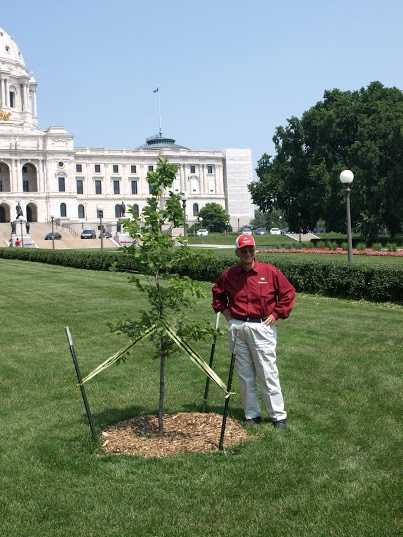
When it came to trees, there are few people who could equal Mark’s passion. He had an insatiable curiosity in the world around us. He lived trees and took every opportunity to discuss them. He discovered the St.… Continue reading this article “Mark Stennes”
When worlds collide
This past week I was in Alnarp, Sweden to present at the International Urban Tree Diversity Conference. Lots of interesting talks, posters and field tours. Much more to discuss than I can fit into a blog post, but if you’re interested you can read the presentation abstracts.
One of the best features of the conference is that the presenters and participants included not only arborists and urban forester but also landscape architects and urban planners.… Continue reading this article “When worlds collide”
Another close shave…
Life is full of surprises. A case in point is some recent work on our Social Media Designed Tree Establishment Study (SoMe-Ded-TrEeS). One of the objectives of the project was to determine the impact of root-ball manipulations to remove circling roots on container-grown trees. When we planted the trees (‘Bloodgood plane trees in 25 gal. containers) two years ago, we ‘shaved’ the outer roots on one-third of the trees, ‘teased’ apart the circling roots on one-third, and planted the rest as-is (‘pop and drop’ in Linda’s vernacular).… Continue reading this article “Another close shave…”
You and me Baby ain’t nuthin’ but mammals…
As spring slowly makes it appearance in the Midwest, homeowners and landscapers are likely to continue discovering damage from our record-breaking winter. While brutally cold temperatures and heavy snow loads took their toll in many areas, some of the most severe damage that occurred to landscape trees and shrubs this winter was caused by mammals.
Our long, harsh winter resulted in heavy feeding damage by deer, rabbits and voles, also called field mice. Depending on the age and type of plant and which animal was feeding on it, mammal damage can range from light pruning to death of a tree or shrub.… Continue reading this article “You and me Baby ain’t nuthin’ but mammals…”
Go ahead, weed, make my day…
Ridding an ecosystem of invasive plants is never easy. We can bring in goats to munch on offending plants or force armies of schoolchildren into slavery to pull them out; but, in all likelihood the sneaky little devils (the invasive plants, not the schoolkids) will be re-sprouting and back with a vengeance before we can turn around. For many invasive plant infestations the most practical long-term solution is chemical control – in other words, herbicides. Of course, herbicides have their issues such as drift and potential impacts on non-target plants.… Continue reading this article “Go ahead, weed, make my day…”
California here we come…
Linda and I are in Sacramento this week for the National eXtension Conference. I will be presenting later in the week on the work that we have done on the SOME-DED-TREES project. More on that in later posts. In the meantime, here are some photos from the State Capitol Park here in Sacramento. If you are ever in the area, I encourage you to check it out since the Park also doubles as an arboretum. The combination of mild winter temperatures and irrigation allows for as wide an array of trees as you are likely to see on one location.… Continue reading this article “California here we come…”
FreezePruf revisited
I received a comment over the weekend requesting an update on an article I posted back in February of 2010 (Wow, hard to believe we’ve been at it that long!) about FreezePruf, a product that is purported to improve freeze tolerance of garden plants. The ingredients and proposed mode of action of FreezePruf are described in my earlier post, so I won’t repeat them here. Back in 2010, there were no published studies available on the efficacy of FreezePruf; just advertising claims from the manufacturer and data that were included in the patent application.… Continue reading this article “FreezePruf revisited”
A DIY Debunking Guide
Debunking myths is at the heart of the Garden Professors blog. The impetus for initiating the blog is rooted in Linda’s ‘Horticultural Myths’ Series and Jeff’s “The Truth About…” books. Unfortunately, I’ve never been especially good at myth-busting or debating. When confronted with someone with deeply held beliefs that are based on misinformation, it usually doesn’t take long for me to lose my cool and my arguments devolve into, “Pull your head out of your a— and face the facts…”
At a holiday dinner not too long ago, a relative suggested “You know, there may be something to the anti-immunization thing…” The words were barely out before I could feel my wife’s hand on my thigh in a futile effort to keep me calm.… Continue reading this article “A DIY Debunking Guide”
It came from the blog… The return of SOME-DED-TREES
Things have been going fast and furious here since the start of the year. We still have a few days left in February and I’ve already logged 13 talks in five states. Nevertheless, I’ve manage to find a little time to crunch some data on SOME-DED-TREES. For the uninitiated, SOME-DED-TREES is the acronym for the Social Media Designed Tree Transplant Study. The project was an opportunity for Garden Professor blog readers to participate in the design of a landscape horticulture research project.… Continue reading this article “It came from the blog… The return of SOME-DED-TREES”