Friday’s freaky flower

Having now depressed my Michigan colleague with my earlier post, here’s a little lighthearted fun for the long weekend:

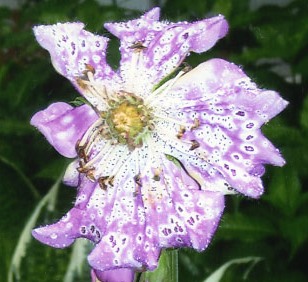
This photo is from Brandi at Fine Gardening.  Can you figure out (1) what it is and (2) why it looks like this?

Monday’s photo will reveal more, and we’ll discuss the second question in more detail.

Have a great holiday – enjoy yourselves!

Dying dogwood diagnosis

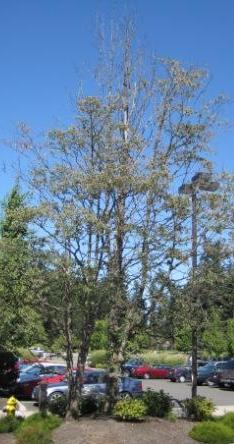
Lots of good, thoughtful answers from you over the weekend about these trees.  Here’s another photo from a bit farther away:
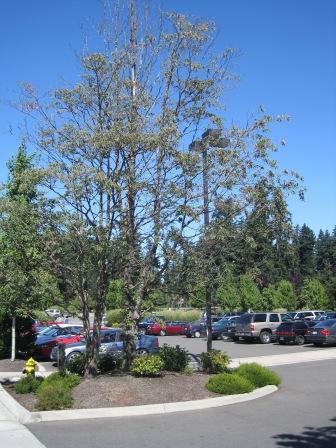
As Laura pointed out, there’s a relatively new parking lot here.  The creation of the parking lot both compacted the surrounding root zone, then covered it with impermeable surface.  The dogwoods are huddled on their little island, which is unirrigated, unmulched, and indeed hot in the summer as Daniel said.  All of these environmental insults, in addition to the mature age of these trees, have led to what we call a “mortality spiral”:  trees are environmentally stressed and then become more susceptible to opportunistic pests and diseases. … Continue reading this article “Dying dogwood diagnosis”
The dilemma of the dying dogwood

Here’s a photo of two mature dogwood trees that are obviously on their way out:

What happened? There’s been no construction in the area since the parking lot was paved several years ago.

Answer on Monday!

Crazy Tree Revealed

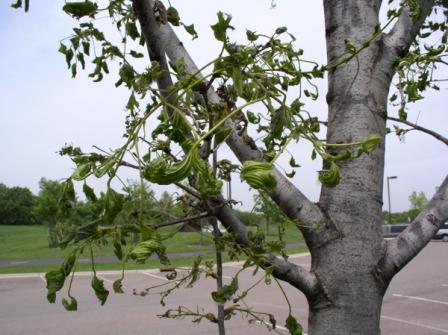
Matt had it right — the tree was indeed an ash — and did not die of its exposure to herbicides — but it did look pretty bad for a year!

What the Heck Is This?

Thought I’d throw up a quiz today.  In the work that I do I frequently see trees and other plants damaged by herbicides.  The plant in the picture below was accidentally hit with an herbicide very similar to 2,4 D, but one that is not currently labeled for general landscape use (clopyralid). Can you guess what type of tree it is?

Icky Friday puzzle solved


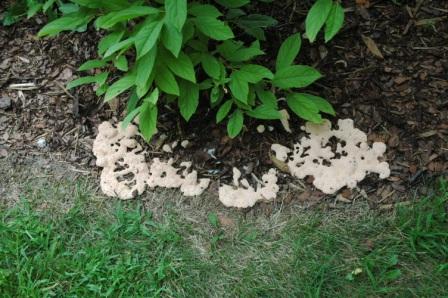
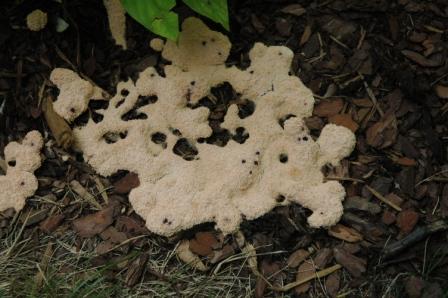
OK, now we know why we usually leave the puzzles to Linda: mine are too easy!  As several folks correctly noted the photo in my yard was an example of the "dog vomit fungus" or, more correctly "dog vomit slime mold" Fuligo septica.  Either way, it’s fairly disgusting and fairly common.  My expereince has been it that it often shows up shortly after I lay dowm some fresh mulch (ground pine bark in this case) and then we get rain and warm temps. … Continue reading this article “Icky Friday puzzle solved”

Friday puzzle time

Was on the road earlier this week and missed my regular post.  Thought I would slide in here with a Friday puzzler.  This one is from my very own yard last week.  Know what it is?

Friday quiz: The case of the bumpy maples


OK, this Friday’s quiz is the real deal: everyone gets to play “Extension Specialist for a Day”.  I am stumped on this and so are my colleagues here at MSU.  I used to work for a guy who liked to say, “None of us is as smart as all of us”.  Let’s put it to the test.

The photos below come from a nursery here in Michigan.  The trees are container-grown Red sunset maples.  Pretty routine crop around here. … Continue reading this article “Friday quiz: The case of the bumpy maples”

Clematis calamity solved

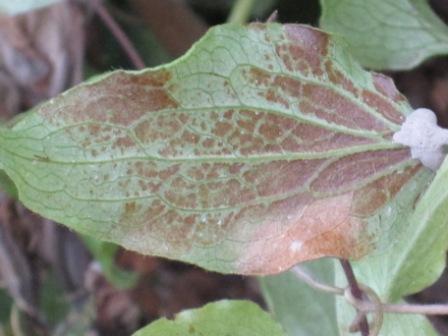
Some good and creative guesses about why the Clematis leaves had interveinal necrosis.  While iron and manganese deficiencies both cause interveinal chlorosis (veins are green, areas between are yellow), the necrosis indicates tissue death between the still-living and green veins.  Very simply, this has been caused by water loss.

During transplanting of the vine, I had to remove them from the fence and lay them out on the ground.  They remained this way for a couple of days. … Continue reading this article “Clematis calamity solved”

Friday quiz – yet more clematis calamity!

If you’ve been following the saga of our clematis, you’ll know that first they suffered iron toxicity (from the waterlogged soil they were in) and then were dug up and replanted in containers.  Last week I showed you what happens when you vigorously work wet soil – yet more waterlogging!  During the transplanting process, I took more pictures:

This damage is NOT from the iron toxicity problem.  It appeared during the transplant process.  What caused it?… Continue reading this article “Friday quiz – yet more clematis calamity!”