I’ve been remiss in getting quizzes posted – partially a time issue, but mostly a lack of interesting photos. But I’ve got one today:
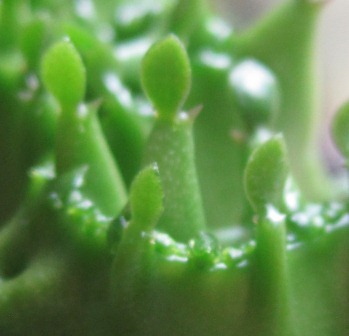
Can you identify what this plant is, and specifically what the little green candles are?
Answers on Monday!
I’ve been remiss in getting quizzes posted – partially a time issue, but mostly a lack of interesting photos. But I’ve got one today:
Can you identify what this plant is, and specifically what the little green candles are?
Answers on Monday!
There are lots of things that people write about that I strongly disagree with. Mostly I keep my mouth shut because my comments would amount to:
A. Preaching to the choir
B. Supporting the phrase "A man convinced against his will is of the same opinion still" (I’m not sure who to attribute this saying to — I’ve seen a few different authors named). My interpretation of this phrase is that you can’t convince someone of something they don’t want to be convinced of.… Continue reading this article “Disagreeing With Colleagues”
At the tail end of August, we (the Hahn Horticulture Garden at Virginia Tech) hosted our second-ever all-day symposium. I christened it the Down ‘n’ Dirty Garden Symposium series – no stuffiness allowed! All fun, all useful info. This year we lured the fab Amy Stewart in as our anchor speaker. Quite the coup for our little town! My friend from grad school, Paula Gross, of the UNC-Charlotte Botanic Garden and co-author of "Bizarre Botanicals" brought her roadshow of wacky plants and action video. … Continue reading this article “Wicked Good!”
This is a tale of three plants in my garden that would make the cruelest of multiple choice answers. Heh. Hence the inclusion of all three in this post:
a. Manihot esculenta
b. Abelmoschus manihot
c. Abelmoschus esculentus
d. All of the above
e. Aaaargh.
Manihot esculenta is Cassava or Tapioca; worthy of an entire post on its own. But the choice ornamental version is M. esculenta ‘Variegata’ or variegated tapioca. I first saw it (gawked and squealed, actually) at Allan Armitage’s fab trial garden at the University of Georgia.… Continue reading this article “Weird and Wonderful Plant Wednesday: Threefer!”
School starts next week and so time is short, but I have a few quick thoughts to share with you before I get back to setting up class for next semester:
1. A class called Plant Production appears to be more attractive to students than a class called Nursery Management and Production — even though the concepts taught are essentially the same.
2. One of the greatest movies of all time, Caddyshack, includes a scene with milorganite. … Continue reading this article “Odds and Ends and Scrapple”
About two weeks ago a reader (Julie) e-mailed me about some young gardeners/farmers and how they believed in a natural balance. The e-mail read: “Would you mind devoting a blog or two to the philosophy that nature is perfectly balanced and will find a solution to whatever ails it and therefore we do not need to use any chemicals or poisons to fight pests and disease?”
I thought this was a good question, and here’s my quick answer (followed, naturally, by a more long and drawn out answer). … Continue reading this article “Striking a Balance”
[Warning: pointless post/ramblings]
Actually it was a "staycation." We usually scoot to the Caribbean for a week. I’d like to say this was better.* Though home from our regular jobs for a week, we worked like fiends. Our primary target was the multitude of Autumn Olive (exotic invasive) and Sycamore (native yet ridiculously prolific) taking over a nice four-acre field. We we don’t quite know what to do with this creek bottom, except to not let it grow up into a monoculture (biculture?)… Continue reading this article “What I did for my summer vacation”
Too easy! Yes, Friday’s evil grin photo was on a head of cabbage (taken on location for this week’s podcast to be posted tomorrow. So yes, Robin, this is YOUR cabbage!).
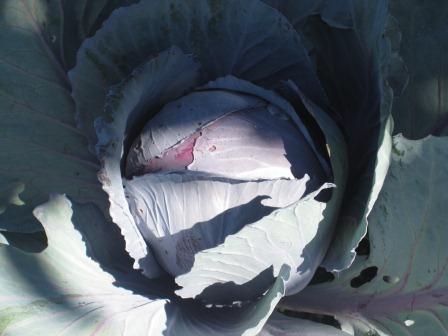
I especially liked the more “creative” answers – you guys are fun!
Another in our ongoing series of mystery plant parts – what am I?

Answer on Monday!
Can’t get anything past our blog readers! Yes, from the highly cropped photo on Friday two readers quickly recognized emerging Indian pipe (Monotropa uniflora):

These plants have no chlorophyll, instead relying on fungal partners who colonize both their roots and the roots of nearby photosynthetic plants. So ultimately this is a parasitic species, as it takes resources from the photosynthesizers in its root network without reciprocal benefit.
These are not commonly found plants, so I think it’s really cool that they appeared in such profusion in a home landscape.