Let’s see if anyone can figure out what this is:
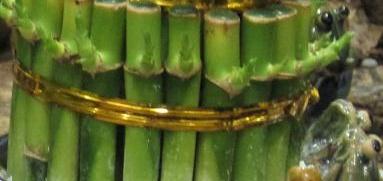
What’s the plant, and what in the world has been done to it?
Answer Monday!
Let’s see if anyone can figure out what this is:
What’s the plant, and what in the world has been done to it?
Answer Monday!
We’re supposed to get an inch or two of snow tomorrow. It was 75 degrees last week. Typical schizophrenic spring weather. But spring was already in full bloom a few weeks ago in Dallas, Texas. Our group of Virginia Tech floriculture faculty and grad students visited for the National Floriculture Forum, a meeting of researchers and educators. It was organized by Texas A&M and hosted by the Dallas Arboretum, home of uber-horticulturist Jimmy Turner.
The Arb was right in the middle of their “Dallas Blooms” festival – they plant half a million spring bulbs each year for the most amazing show this side of Keukenhof. … Continue reading this article “It’s Spring-o’clock Somewhere…”
Great debate on the identity of Friday’s mystery plant! Several of you guessed larch, and this particular one is contorted larch (Larix kaempferi ‘Diane’), a cultivar of Japanese larch:
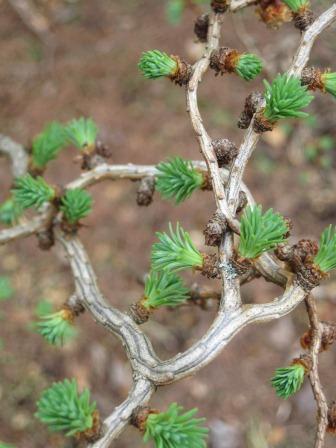
(As an FYI to a side discussion in the comments, tamarack is the common name for American larch, Larix laricina.)
And the eagle eye award to those of you who saw that YES! WE FINALLY HAVE A SEARCH FUNCTION on the blog! It’s still being tweaked so that the results pages will be a little more sophisticated, but it works.… Continue reading this article “Looks like larch!”
Here’s the mystery plant part for the week:
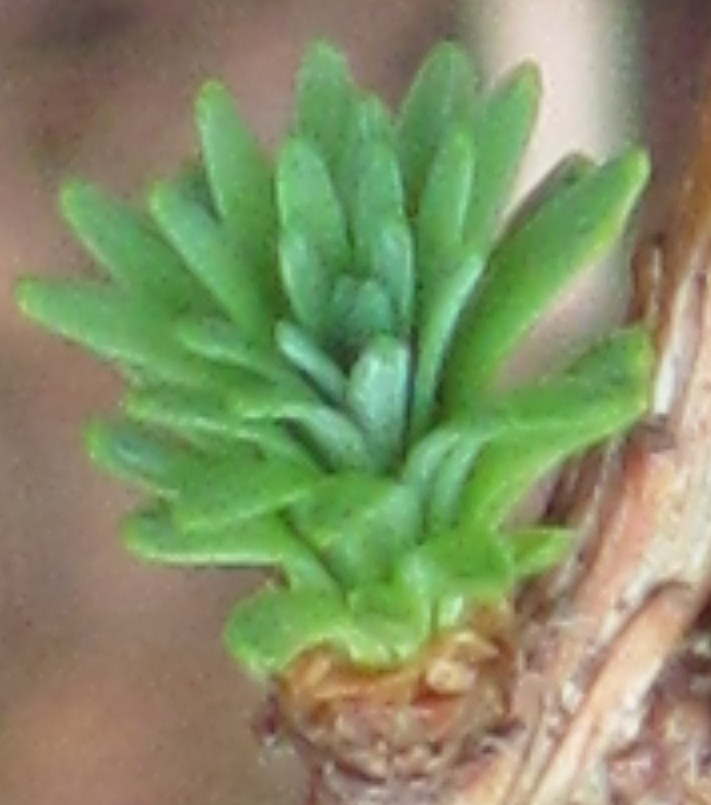
Now for question number two: there’s something new on the blog this week. Can you find it?
Answers on Monday!
Over the last two weeks I’ve been dwelling on the information that people get about gardening from various sources. I’m not talking about really serious gardeners – I’m talking about the guy down the block who might grow six tomatoes, two cucumbers, and a head of lettuce. He’s got 6 trees on his property and he keeps his lawn nice, but not immaculate, by mowing weekly and fertilizing and applying herbicides once a year. Where is this guy getting his gardening information? … Continue reading this article “How to get the information out?”
You were too smart for me this week. Though my husband was convinced that Friday’s photo was not enough to help identify the plant, JRR, Foy, and an unnamed commenter all recognized hellebore:
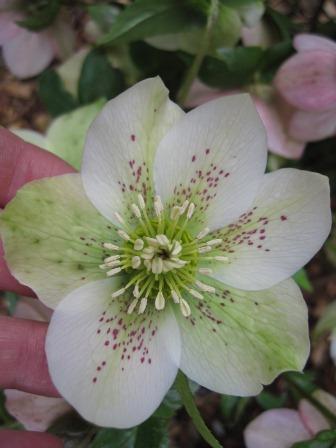
Always a welcome sight in the spring. And don’t be fooled by those old wives’ tales that hellebores don’t like wood chip mulches. These beauties have been in wood chip mulches all their lives, and not only do they do great, their seedlings do as well.
I finally got a chance to get outside (translation: it stopped raining) and took this photo:
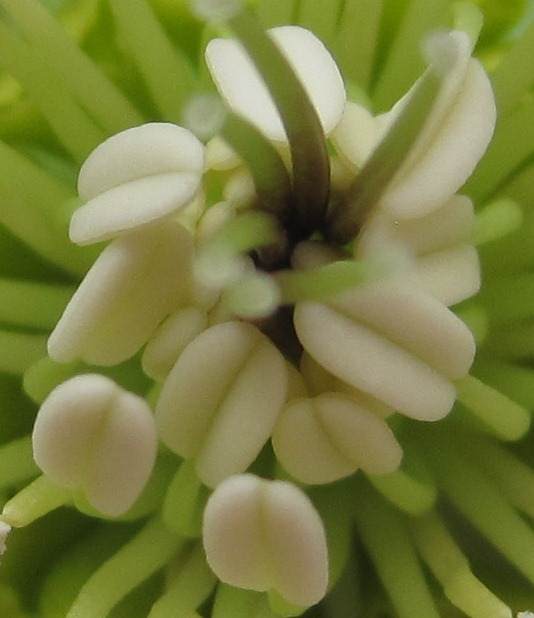
They kind of look like barley grains, but I’m sure you know they’re not! The questions are – what are they and to what plant do they belong?
Answer Monday!
We had a flurry of discussion on this over the weekend. The diversity of possible answers shows you how difficult it is to do diagnosis with only some of the information available. That being said, several of you (Gail, Tom, Dave and Jimbo) all had portions of the problem identified. Here’s the whole picture:

As both trunks of this double-leadered tree have continued to expand in girth, they’ve created the perfect conditions for disease to occur in the narrow constriction between the trunks.… Continue reading this article “Wet trunk – the whole story”
Another diagnostic question today. Below you can see the lower portion of a tree trunk whose left half is obviously wet:
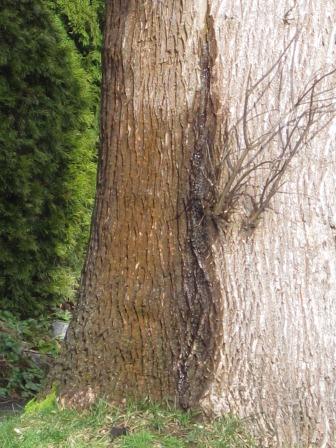
What is directly causing the wetness (in other words, what environmental factor), and can you guess what led to this problem indirectly?
I’ll eliminate some of the obvious possibilities: it’s not from dog pee, nor is it from a directional sprinkler. And the answer to the second question is not in this close up photo, but will be revealed on Monday.… Continue reading this article “Friday puzzle: wet trunk”
There were several good shots at analyzing Friday’s unhappy rhododendron. Mature leaf size can be determined by light levels, as both Lisa B and Tom & Paul suggested. Moving a plant from a low to high light environment could cause this change in leaf size. This rhododendron hasn’t been recently transplanted, however, so we can eliminate light levels as a cause. (And there was no other impediment to light, such as the presence of shading plants.)… Continue reading this article “The roots of the rhody problem”