I have another post to toss up later today, but first I thought I’d direct your attention to the comments on a post from a few days ago — The post titled International Ag Labs – who are they and what do they do? It’s fascinating to see so many people discussing the benefits of IAL (and more fascinating to read their comments…some of which are thoughtful and some of which are….less thoughtful). The reason that there are so many of them is that IAL apparently sent out a blanket e-mail to their customers to try and get them to respond to Linda’s post. … Continue reading this article “The Fun Never Ends Here At Garden Professors!”
Category: Amusing Facts
Plant Patents
I love patents. In fact, I once wrote a novel based on a patent — It was called Patent 22 — If you look this patent up you’ll just find a piece of paper from 1915 which says, essentially, that a search was made for the patent but that it couldn’t be found. No one wanted to publish it — and reading it now I do realize that it does need some serious work. Still, I think this little tidbit gives you a little bit of an idea about my interest in patents. … Continue reading this article “Plant Patents”
All Right, Linda; I’ll See Your Paraheliotropism and Raise You a Nyctinasty
Amicia zygomeris is a cute little herbaceous thing I picked up on a visit to Plant Delights nursery back in October. For $13, I wanted to be sure it survived the winter, so it’s been in our kitchen garden window, just waiting for spring.
Soon after putting it in the window, I had an “oh no, I’ve killed it” moment one evening. All the leaves were drooping, yet the soil was moist. The next morning, it seemed to be back to normal. … Continue reading this article “All Right, Linda; I’ll See Your Paraheliotropism and Raise You a Nyctinasty”
Friday puzzle answer(s)
Wow! What a lot of great brainstorming over the weekend! I would venture to say that The Garden Professors have the smartest students in the world.
On to the answer…or answers. First, the phenomenon. It’s called paraheliotropism – literally, a movement to protect (the leaves) from the sun (yes, Trena, it is a tropism!). This is the opposite of another phenomenon called heliotropism, or solar tracking. Sunflowers famously do this, as do a number of arctic species that collect solar warmth for the benefit of their pollinators. … Continue reading this article “Friday puzzle answer(s)”
Friday puzzle
Spring is coming…and soon herbaceous perennials will poking their leaves up through the mulch:
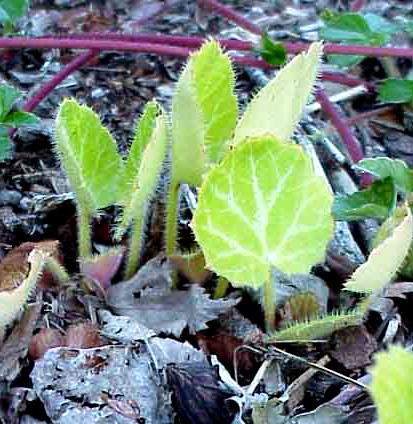
Obviously as leaves first emerge they’ll be vertically oriented – but these ones have remained vertical days after emerging. Eventually they’ll become horizontal. But today’s question is – what’s the advantage in remaining vertical? And what’s this phenomenon called?
Answer on Monday – have a nice weekend!
Mistaken Identity, or The Truth?
In the wake of The Garden Professors’ sudden notoriety (see Linda’s Jan. 26 post), my department head sent out a very kind e-mail announcement to our faculty, staff, and grad students.
However, he referred to us as the "Hort Professors" blog, sans hyperlink.
A curious staff member (the lovely and talented Pris Sears) searched that title, resulting in the following:
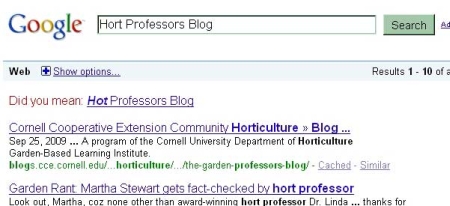
Hort Professors, Hot Professors…kind of the same thing. Thanks, Google!
Friday Physiology Fun Followup
Astute readers pointed out several morphological adaptations found in drought-tolerant turf weeds: fleshy taproots, reflective leaf surfaces, etc. What we can’t see is what many of these plants do physiologically – and that’s photosynthesize using a biochemical pathway that temperate turfgrasses don’t possess.
This pathway, called C4 photosynthesis, contains some extra preliminary steps not found in plants using traditional (C3) photosynthesis. The downside: it takes more solar energy for the plant to photosynthesize. The upside: these extra steps allow the plant to "fix" carbon (transforming it from gas to solid) faster, especially when it’s sunny, warm, and droughty. … Continue reading this article “Friday Physiology Fun Followup”
Friday physiology fun
It’s still cold and wintery, so let’s imagine ourselves in a happy place…warm, sunny, dry…with dead lawns.
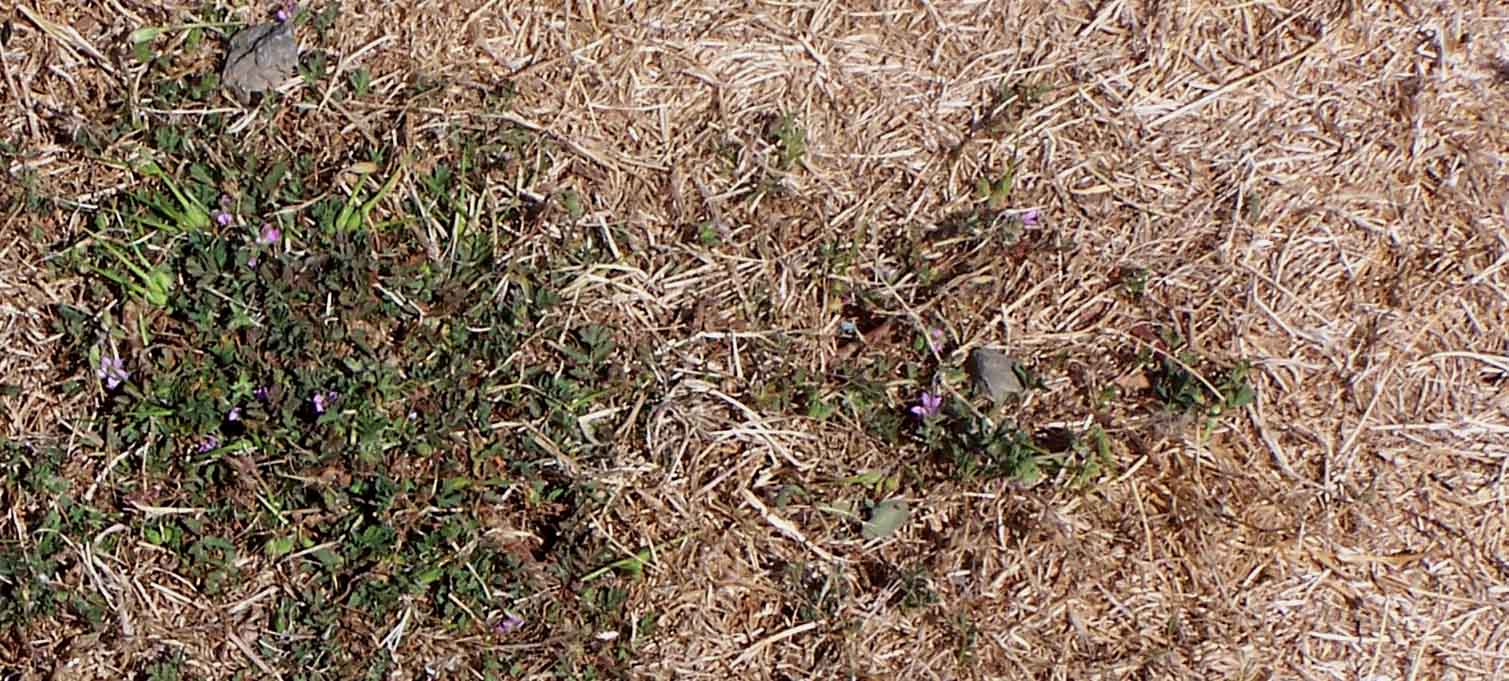
As the photo shows, the turfgrass is dead; this happens every summer during the Pacific Northwest’s droughty summers. Yet many of the weedy species are obviously thriving. Why?
Remember, this is a physiology quiz. You can discount herbicides, fertilizers, etc. This is a cool (no pun intended) adaptation that many species native to dry, subtropical to temperate environments possess. … Continue reading this article “Friday physiology fun”
Making a difference?
I promise I’ll post a Friday puzzle later. But I just had to let you know that if you Google “water droplets burn leaves” (without quotes) you’ll get 436,000 hits as of this morning. Number 3 on the list? Our blog!
I think I’ll discuss this paper one more time on Wednesday – there are several other serious issues that I think are worth mentioning.
Have a good weekend!
Help! Help! The Sky is Falling!!!
You all remember the story of Chicken Little, right? Chicken Little thought she’d been hit on the head by a piece of the sky and ran around alarming the rest of the barnyard animals, who assumed Chicken Little knew what she was talking about. Had they not all been eaten by Foxy Loxy, I’m sure they would have felt foolish discovering that an acorn, not a piece of the sky, had bopped Chicken Little on the noggin.… Continue reading this article “Help! Help! The Sky is Falling!!!”