My summer vacation

I’m following Holly’s lead and slipping into fantasyland today.  Though this part of the country has no snow, it is a typical cool, misty and gray winter morning in Seattle.  So I’m going to a happy place and reminiscing about my summer vacation to Sechelt, British Columbia.

Sechelt (pronounced like “seashell” with a “t” at the end) is a lovely place full of wonderful people (and great gardeners!), but I’m going to focus on the coastal rock gardens at Smuggler’s Cove Marine Provincial Park. … Continue reading this article “My summer vacation”
So much for my happy summer vacation

It figures.  After I write a happy post I get an email question that brings me back to reality.  I plan on sharing a little more about the question – and my answer – with you later, but I’m going to give you some homework.  Let’s see what you can find out about these topics:

International Ag Labs

High Brix Gardens

Reams’ Biological Theory of Ionization

Hint: they are all interrelated.  Post your comments on the blog and let’s see where we go with the discussion.

Friday puzzle untangled

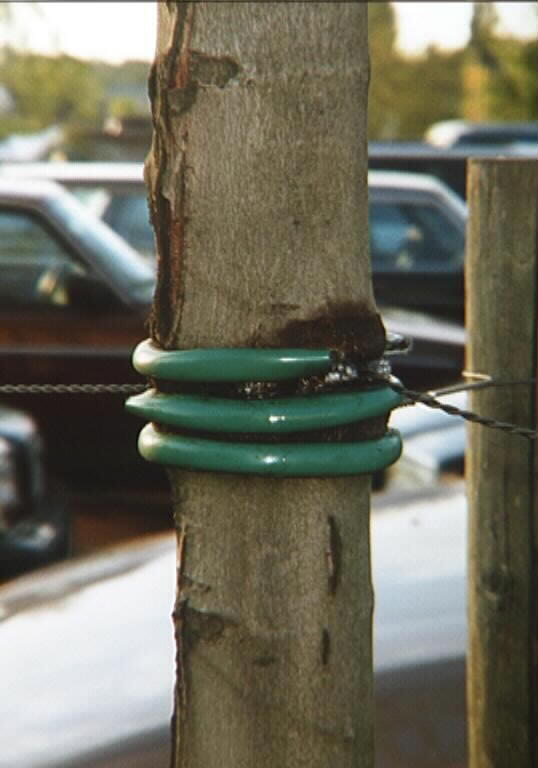
Well, either the puzzle was too easy or you guys are too smart!  Deb, Christopher, Lori, Foy, Jim, and Hap go to the head of the class – it was, indeed, staking material left on way too long.  Here’s a photo from over 10 years ago.  I’m not sure this is the very same tree, but it’s from the same parking lot/torture chamber:

I “liberated” these trees with my handy wire-cutters (never leave home without them) shortly after taking the pictures. … Continue reading this article “Friday puzzle untangled”

Friday quiz…better late than never!

As you know, I wanted to get something intriguing for this week’s puzzler from the NW Flower and Garden Show.  Alas, there was nothing that jumped out at me, so I’m digging into my photo archives.

Here is a recent photo from a parking lot tree.  About four feet up the trunk, I found this interesting growth.  No, I don’t know what the tree species is because (a) it wasn’t in leaf and (b) I’m a taxonomy klutz. … Continue reading this article “Friday quiz…better late than never!”

Friday quiz…yes it’s coming

As you might know, I’ve been at the NW Flower and Garden Show this past week, and yesterday I had two seminars to give.  So I didn’t have a chance to post a quiz, and this morning I’m back over for a few hours before I’m done.

I’m hoping to find an interesting Garden Prof question topic at the show, so I’m taking the camera today.  If I can’t, I have a backup.  But I promise there will be a question up by today!

Water droplets and burned leaves, continued

A few weeks ago (January 20 – “Help, help, the sky is falling”) I started a discussion about an article appearing in the peer-reviewed journal New Phytologist.  That posting focused on the methodology and results in the paper.  Today let’s take a look at the authors’ underlying arguments (their introduction to the study) and their conclusions.

1)  The authors’ premise is that “laymen and professionals alike commonly believe water drops on plants after rain or watering can cause leaf burn in sunshine.” … Continue reading this article “Water droplets and burned leaves, continued”

Friday puzzle answer(s)

Wow!  What a lot of great brainstorming over the weekend!  I would venture to say that The Garden Professors have the smartest students in the world.

On to the answer…or answers.  First, the phenomenon.  It’s called paraheliotropism – literally, a movement to protect (the leaves) from the sun (yes, Trena, it is a tropism!). This is the opposite of another phenomenon called heliotropism, or solar tracking.  Sunflowers famously do this, as do a number of arctic species that collect solar warmth for the benefit of their pollinators. … Continue reading this article “Friday puzzle answer(s)”

Friday puzzle

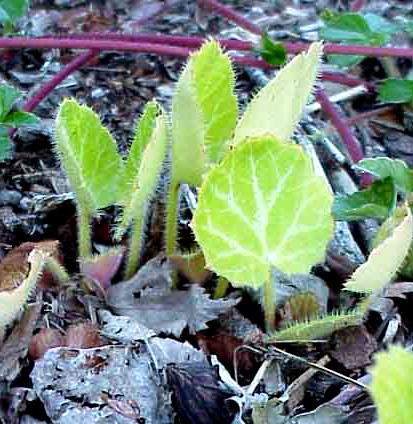
Spring is coming…and soon herbaceous perennials will poking their leaves up through the mulch:

Obviously as leaves first emerge they’ll be vertically oriented – but these ones have remained vertical days after emerging.  Eventually they’ll become horizontal.  But today’s question is – what’s the advantage in remaining vertical?  And what’s this phenomenon called?

Answer on Monday – have a nice weekend!

“Being wrong” counterpoint

I haven’t finished with the water droplets story yet – but I just had to add some more evidence to the tree planting discussion from last week.

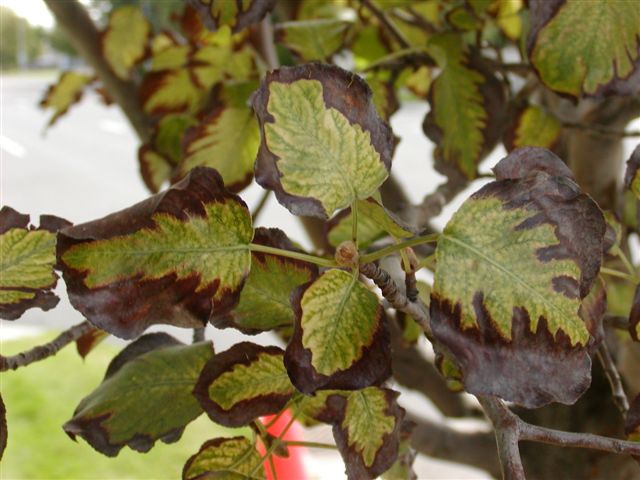
Consider this series of photos below.  This is a street tree in Kennewick, WA (in the southeastern part of the state, where summers can be intensely hot and dry).  Every spring, this tree leafs out just fine – and every summer the leaves suffer marginal and tip scorch.  This is a classic symptom of chronic drought:

As an amenity, the tree fails. … Continue reading this article ““Being wrong” counterpoint”