Fungal fun continues!

The comments on Friday’s puzzle have certainly been imaginative!  (Tribbles indeed!)  But this weekend nature cooperated to give me some more information.

My little fungus family expanded over the weekend.  As this photo shows, we definitely have a mushroom-type fungus:
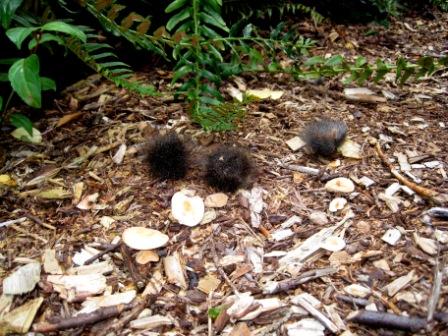
Looking at a young member, you can see what look like stalked spores emerging from the gills:
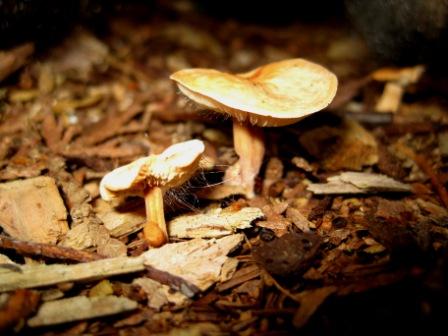
And the edges of the mushroom curl upwards as the spore mass grows
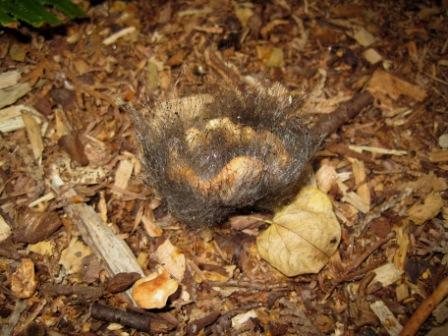
until we end up with the black furry ball shown on Friday:
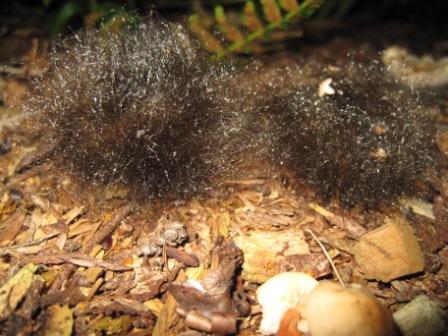
So the discussion continues:  What the heck is this? … Continue reading this article “Fungal fun continues!”
Friday fungal fun

The answer to today’s puzzle will depend on YOU!  I have no idea what this is.  (I’m not a mycologist.  And did you know that fungi are more closely related to animals than to plants?)

Anyway.  I found this on our wood chip mulch today.  We always get interesting fungal fruiting bodies on wood chips – one year we even got morels.  But I’ve never seen this type before.

If you can’t tell, these are round and furry. … Continue reading this article “Friday fungal fun”

Tips for garden writers from a science writer

Much as I am itching to continue the current discussion on cultivars of native plants, I’ve got to wait until next week (my seminar schedule has me hammered – doing my third one this week tomorrow).  So instead I thought I’d throw out some suggestions for those nonscientists who blog and/or write about all things planted.

First of all, I do enjoy reading blogs, articles and books by nonscientists who venture into plant and soil sciences. … Continue reading this article “Tips for garden writers from a science writer”

Mystery tongue identified

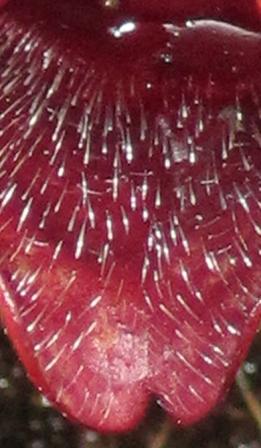
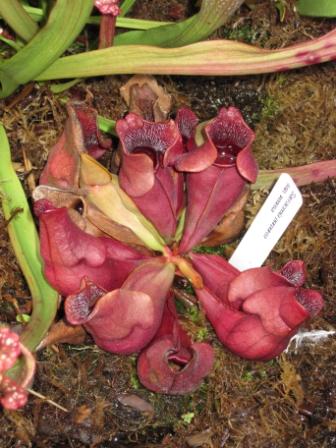
A few brave souls dared to take on Friday’s puzzle.  Here’s a more revealing photo; the "tongue" is actually the top of a pitcher plant: 

Kudos to Hap for correctly identifying the genus (Sarracenia) of this carnivorous plant.  This particular one is S. purpurea, which is distinctive in that it has dark red, open pitchers rather than hooded ones.  You can easily see the downward slanting hairs in the throat of the pitchers.  These hairs, as Diana pointed out, keep trapped insects from climbing back out of the pitcher. … Continue reading this article “Mystery tongue identified”

Cat tongue?

Well, maybe it’s not a cat tongue (no way my cats would put up with this), but what is it?  Name both the plant and the function of this tissue for full credit!

Answer and more photos on Monday – have a great weekend!

Off with their heads!

About a year ago I posted my thoughts about the nursery production practice of heading young trees (“whips”) to stimulate lateral branching or columnar form or whatever.  (You can find this original column here.)  A healthy discussion ensued, much of which revolved around the need for appropriate follow-up pruning to ensure the development of a stable crown structure of headed trees.

Fast forward to last month, where a column I wrote for NPM (Nursery Production and Management) magazine hit the web. … Continue reading this article “Off with their heads!”

Turf trickery

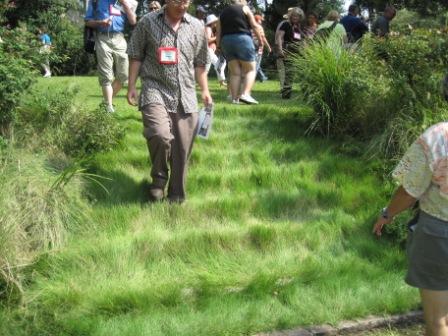
Now I feel a little guilty.  You tried to answer Friday’s puzzle so seriously, and I was taking liberties with photography:

I think this is the coolest garden stairway I’ve seen yet.  The buffalgrass tolerates moderate foot traffic, and it lends a fluid look to the otherwise hard edges of the steps.  And you can’t tell from looking, but it both felt and sounded silky.  Best of all, it doesn’t require mowing.  (This is the Rolston/Cohn garden, part of the garden tour put on by the GWA in Dallas last week.)

Dallas mystery turf

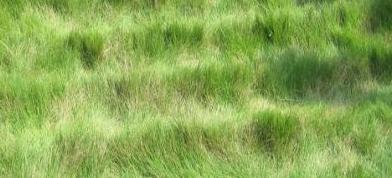
During my trip to Dallas last week, I saw several low-water lawns, including this one using buffalograss (Bouteloua dactyloides):

The question is – why does have this wave structure?

Another revealing picture and answer on Monday!

Sheet mulching – benefit or barrier?

Alert reader Matt Wood pointed out a recent article in the NY Times on mulching with newspaper and wondered about my take on the topic.

For use on landscapes, I do not like sheet mulches of any stripe.  They tend to hinder to air and water movement, most especially in unmanaged landscapes like restoration sites.  A classic example is the use of cardboard or newspaper covered with wood chips.  The chips are easily dislodged, exposing the sheet mulch which quickly dries out and becomes hydrophobic. … Continue reading this article “Sheet mulching – benefit or barrier?”

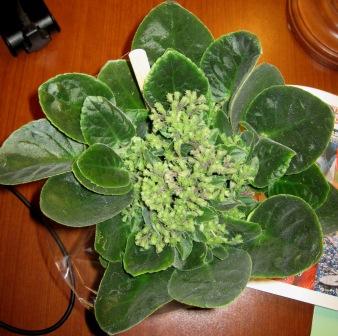
A freakin’ violet

Friday’s puzzle scared you off!  Matt was correct – this is an African violet (Saintpaulia spp.).  But unlike other African violets, this one never opens its flower buds (Sandy nailed it!).  Originally cultivated in Germany, these plants are marketed in the US by Optimara Violets.  That’s all I can tell you about this quirky little cultivar.