Solution to Friday’s flower fuddlement

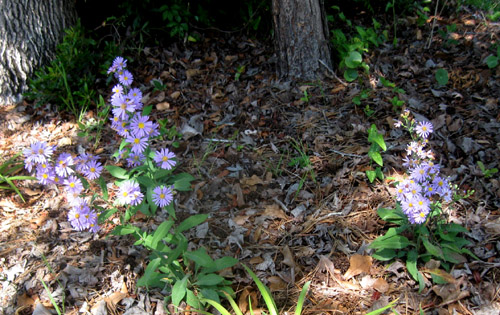
Ed and Gayle correctly pointed out that short day plants (those that bloom in the spring or the fall) can sometimes do both.  The asters probably experienced some transplant shock in the fall, which would have suspended floral bud development.  This phenomenon could also be due to mild winter conditions (as Ed and Gayle also mentioned), which could have spared flower buds normally killed by freezing temperatures.

In any case, as spring daylengths approached those found in the fall, flower development continued and voila! … Continue reading this article “Solution to Friday’s flower fuddlement”
Floral fuddlement

Gardeners love asters as part of their autumn floral palette.  Yet these native asters are blooming now – in the spring!

These specimens were purchased last summer and planted in the fall in Florida. Why might they be blooming out of season?

Reader Ginny Stibolt contributed today’s puzzle.  If you’d like to be a guest inquisitor on our blog, send photos and explanatory text to Linda Chalker-Scott.

Mystery sparkler exposed

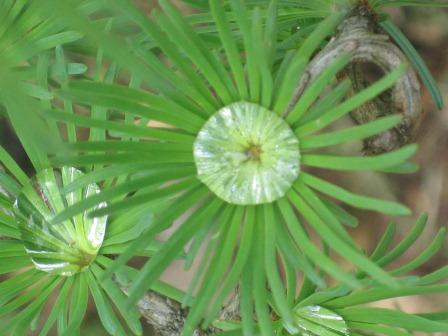
I really liked the answers you brave few came up with for Friday’s photo.  I could absolutely see how each one made sense – but unfortunately none of them were correct.  It’s actually a raindrop sitting on top of an expanding larch bud:

This turned out to be much trickier than I anticipated.  I promise the next one won’t be.

(And no, the raindrops do not magnify sunlight and cause the expanding needles to burn!)

Mystery sparkler

What am I?  (There are two distinct entities.)

Answer and a complete photo on Monday!

Sunday addendum:

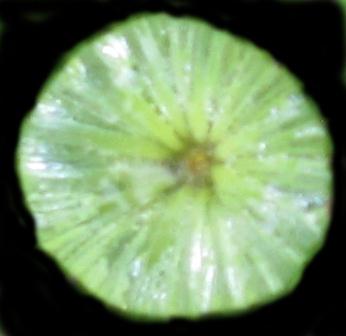
No guesses yet…maybe it’s too tough?  Here’s a more revealing photo:

What to do when it’s still raining?

It’s almost May…and it’s still raining. Even for our normally wet spring climate, this has been an unusually soggy year. I’m also blaming the weather on my 3rd or 4th cold so far this year, which has knocked me flat for the last 6 days (which was why I had no Friday puzzle posted). So in between blowing my nose, hacking my lungs out, and generally feeling sorry for myself, I started looking over 10 years’ worth of photos of our home landscape.… Continue reading this article “What to do when it’s still raining?”

Mortal Kombat – garden version

Soil solarization is regarded as an environmentally friendly alternative to pesticides for controlling nematodes, weeds and disease.  Sheets of plastic (generally clear) are spread over the ground and solar energy heats the soil underneath to temperatures as high as 55C (or 131F).  Since the soil environment is usually insulated from temperature extremes, the organisms that live there are unlikely to be resistant to heat stress.

This is a practice best suited to agricultural production, where monocultures of plants have attracted their specific diseases and pests. … Continue reading this article “Mortal Kombat – garden version”

Guest inquisitor reveals all

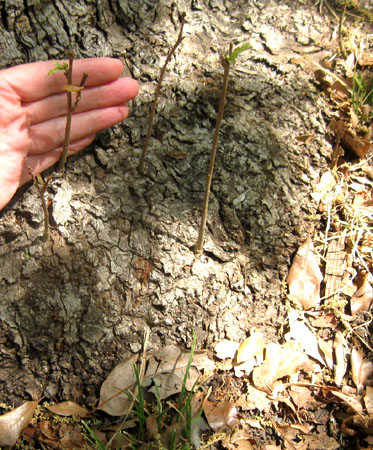
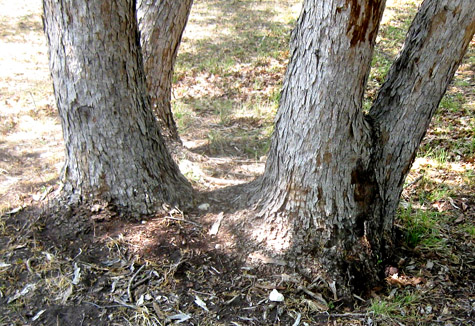
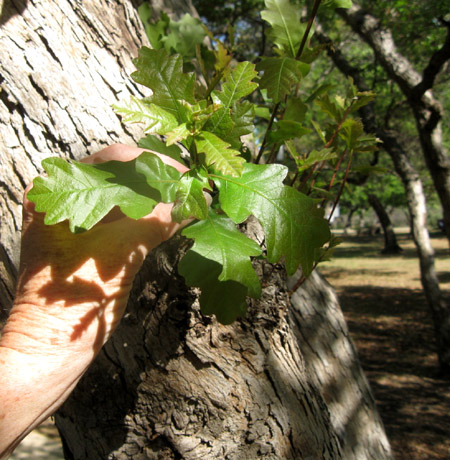
The odd oak in Friday’s photos is shin oak, or Quercus sinuata var. breviloba:


This trunk “puddle” is a really cool adaptation called a lignotuber (good job Matilija!) or burl.  These are common in woody plants found in wildfire zones.  New sprouts can arise after fires have roared through, or perhaps after heavy browsing by deer, as the park ranger suggested to Ginny, our guest inquisitor.

Thanks, Ginny, for sharing the photos and question.  If you have an interesting plant quiz topic, preferrably with pictures, feel free to pass it on for our Friday Question!

Friday quiz – guest inquisitor!

Reader Ginny Stibolt passed this one on to mull over the weekend:

“We stayed at the Llano River State Park in Texas where I spotted this weird growth pattern of a gnarly oak–it’s like a puddle of trunk from which the main trunk arises. The camp host, who seemed to be well informed, said that these were Spanish oaks in the white oak division and that a root disease causes the expansion of the base of the trees.… Continue reading this article “Friday quiz – guest inquisitor!”

Invasive plants, politics and science

I’ve had a hectic week (taxes! financial aid!) and haven’t had a chance to think about posting.  Fortunately, yet another colleague just sent me an interesting link that’s worth sharing and discussing.

For those of you who aren’t familiar with how Master Gardener programs work, they are built on volunteers who receive training in garden-related sciences and then contribute a significant number of hours to outreach education.  Many MGs work in plant clinics, and others volunteer in public gardens. … Continue reading this article “Invasive plants, politics and science”

Interesting and useful web site about invasive insect pests

Just heard about this from a colleague. This website has a link to a great image gallery of exotic insect pests. Though it’s primarily geared towards forest pests, the urban forest is just as susceptible.