Quiz answer – difference between spores and pollen

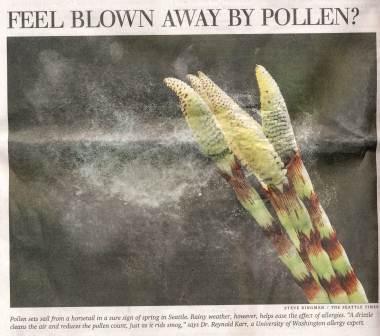
You got it!  Horsetails don’t produce pollen, and those airborne particles are spores.  Primitive plants such as mosses, ferns, and horsetails don’t have the same reproductive structures as flowering plants and conifers. Instead of producing seeds, they form tiny, windborne spores that can be mistaken for pollen.

(To its credit, the Seattle Times corrected this error the next day.)
Friday quiz – what’s wrong with this picture?

My sharp-eyed husband spotted this on the front page of yesterday’s paper:

What's wrong with this picture

Answer Monday!

WOW returns! (Why oh why?)

It’s spring, and everyone is itching to buy stuff at the nursery.  I’m there too, with my camera as well as my wallet.  I thought you might enjoy some of my “Things to avoid when you are plant shopping” collection:


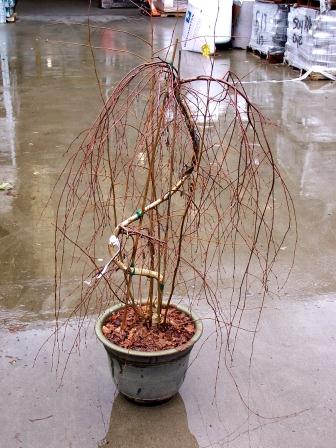
These are called “Serpentine.”  I call them unnatural.  Like foot-binding.

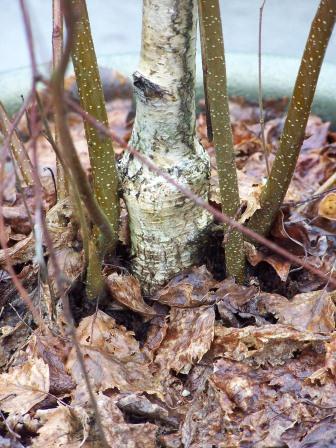
Rootstock revolt.  The surest way to kill off your grafted scion.
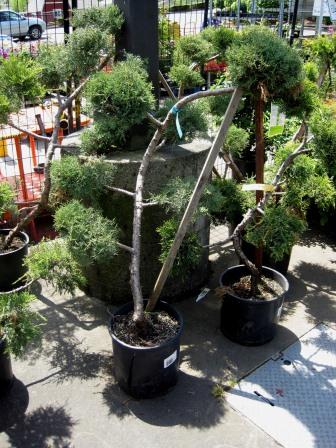
A botanical bow?  Or a horticultural harp?
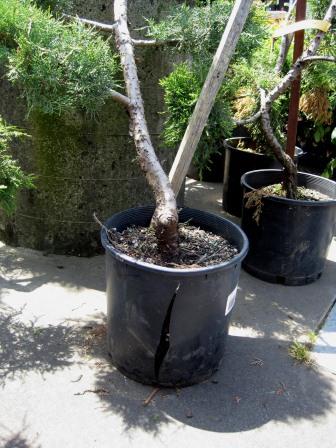
And check out the pot!  If there’s enough root mass in there to crack the pot, you can bet it’s long past its potting up date.… Continue reading this article “WOW returns! (Why oh why?)”
Bokashi composting and Effective Microorganisms® – a quick analysis

A few weeks ago an attendee at one of my seminars asked me about bokashi composting.  It’s a term I hadn’t heard before, so I promised to look into it (and the science behind it, of course).  I haven’t had a chance to do much more than a cursory analysis, but even that has proven interesting.

For those of you who, like me, had never heard of bokashi, it’s a composting technique that utilizes Effective Microorganisms® as a way of creating a “positive” compost product using “positive” microorganisms. … Continue reading this article “Bokashi composting and Effective Microorganisms® – a quick analysis”

An update on the APLD’s soils guide

A few weeks ago I posted on the disappointing inclusion of compost tea in the APLD’s Guide to Sustainable Soils.  Included in my discussion of the issue was the suggestion that people involved in writing the guide also benefited financially from compost tea applications.  This led to some very honest and constructive emails between me and the APLD’s national leadership, which resulted in educating both parties.

Here’s what I found from the APLD’s President Susan Olinger and Sustainability Chair Toni Bailey:  As members of the Board of Directors of APLD, we can verify that there was no financial motive behind the inclusion of compost tea by the volunteers that wrote the soils guide.” … Continue reading this article “An update on the APLD’s soils guide”

The Living Desert

I had to laugh at Bert’s post about how warm it is in Michigan. Two days ago I drove to Vancouver BC from Seattle through a snow storm. Sigh. I’m already wishing I was back in Palm Desert…so today I’ll introduce you to The Living Desert, one of my favorite plant places to visit. It’s got stellar display gardens featuring the vegetation of the southwest desert ecosystems, all labeled, with tidbits of information on natural history, medicinal uses, etc.… Continue reading this article “The Living Desert”

Dry doesn’t have to mean dull!

I’m on vacation this week in Palm Desert, California – part of an annual ritual that I’ve enjoyed for about 30 years. Nearly the first thing I do while I’m down here is get away from the golf courses and shopping malls into the high desert mountains. Yesterday my daughter and I hiked Horsethief Creek trail (great name, huh?) in the San Bernardino Wilderness and admired the spring flowers that are just starting to emerge.

One half of my brain was busy noticing all of the native plants that I felt had great ornamental value for home landscapes, while the other half worried about what to do for my blog posting this week.… Continue reading this article “Dry doesn’t have to mean dull!”

Taking gardens to a new level

I spent the last few days in New Jersey, with a quick day trip into NYC.  It was a perfect East Coast winter day – sunny and cold – while back home in Seattle it rained.  So it was with real joy that I hoofed it through some of the city’s greenspaces, ending up at The High Line.

I won’t go into detail about the site’s history and development of this city landscape, because the link will do that much better and with more authority than I can. … Continue reading this article “Taking gardens to a new level”

Compost tea – now part of landscape design?

I spent yesterday at the Washington APLD meeting in Seattle (that’s the Association of Professional Landscape Designers) – a new venue for me.  In my relatively short time frame I focused on one example of an unsustainable practice (overamendment of soils with organic matter) and an unsubstantiated product (compost tea), both of which I knew were of interest to this group.  I came away with a lot of new colleagues and a shared sense of excitement that landscape designers, like other horticulture professionals, also want the best science on which to base their recommendations.… Continue reading this article “Compost tea – now part of landscape design?”

An uphill battle for evidence-based products

I was idly scrolling through Facebook, thinking about my topic for today, when I saw a link for “federal guidelines for sustainable landscaping.”  Perfect!  I skimmed through the document – some quibbles here and there, but nothing gasket-blowing on my first read – and then checked out the BioPreferred Catalog page.  I looked under “Landscaping and Agriculture” and clicked on “Fertilizers.”

There are 182 listings.  The very first one is “1-2-3 Instant Compost Tea.” … Continue reading this article “An uphill battle for evidence-based products”