Winter appears to have a death grip on the eastern half of the U.S. for the second year in a row. The thermometer on my car read -6 F on my way into work this morning; with lows of -5, -11, and -2 predicted for the latter half of the week. And to my Northwest friends that have been out mowing their grass already, may the bird of paradise fly up your nose. At this point I don’t even remember what my lawn looks like.… Continue reading this article “Plants for winter interest: Going for the Gold”
Tag: conifer
What’s wrong with my pine tree…? Nothing!
Every once in a while in this line of work we’re actually able to give a homeowner some good news about their trees. A case in point is a call that we frequently get this time of year that starts like this: “My pine tree looks like it’s dying! It’s dropping all of its needles!” If the caller has access to the internet and a digital camera I usually request that the send me a couple of photos; if not, I ask them whether the tree is shedding needles along the outermost part of the limbs or on the interior.… Continue reading this article “What’s wrong with my pine tree…? Nothing!”
Silence of the lamb chops
One of my ‘other duties as assigned’ this time of year involves serving as The Christmas tree Guy and responding to various media inquiries about Christmas trees. Last week I posted a link to a media story about Christmas trees on the Garden Professor Facebook page. That post drew a response from Kyle Fletcher Baker who derided cut Christmas trees as “murder of the innocent.” My initial reaction was, “Jeez, Kyle we’re talking about fir trees here not lamb chops or veal.”… Continue reading this article “Silence of the lamb chops”

You don’t have to be crazy to work here, but it helps
Recently I spent a week in Oregon working on a Christmas tree genetics project along with my colleagues Chal Landgren( Oregon State University), Gary Chastagner ( Washington State University), and John Frampton (North Carolina State University). The objective of the project is to identify superior seed sources of Turkish fir and Trojan fir for use as Christmas trees around the United States. We refer to the project as the Cooperative Fir Genetic Evaluation or CoFirGE – remember, the most critical step in any experiment is coming up with a catchy acronym. … Continue reading this article “You don’t have to be crazy to work here, but it helps”
Imprelis update
I’ve been continuing to track some of the reports of injury to conifers associated with the new herbicide, Imprelis. Interest in the problem is likely to escalate given a front page article in the Sunday’s Detroit FreePress. http://www.freep.com/article/20110710/NEWS06/107100467/New-lawn-chemical-chief-suspect-mysterious-deaths-trees
I visited about ten sites last week with an applicator that had used Imprelis this spring. The landscaper was a certified applicator with about 15 years of experience with herbicides, insecticides and fungicides, who was knowledgeable about his chemicals and plants.… Continue reading this article “Imprelis update”
Spruce brown-out solved
Gall adelgids are certainly a problem in these parts, especially on blue spruce. But the ‘problem’ in this case is not a pest. This year, as in several recent years, spruces are developing copious amounts of pollen cones. Once the pollen is shed, the cones dry up and turn brown. Many homeowners mistake these for insect galls or sign of some other pest activity.
In many conifers, pollen cones occur on the lower portion of the crown while seed cones occur in the upper third as an evolutionary adaptation to reduce selfing.
… Continue reading this article “Spruce brown-out solved” In many conifers, pollen cones occur on the lower portion of the crown while seed cones occur in the upper third as an evolutionary adaptation to reduce selfing.
Friday Quiz: Spruce brown-out?
We’re beginning to see signs that we may be getting a lot of calls on spruces this year similar ones we experienced a couple of years ago. Homeowners and landscapers are calling in with reports of brown ‘growths’ on spruces – particularly white spruce and some on Colorado blue spruce. The growths can be quite noticeable, even from a distance and cause trees to take on a brownish cast; usually most prevalent on the lower 2/3rds or so of the crown. … Continue reading this article “Friday Quiz: Spruce brown-out?”
Blue Spruce Blues
One of the roles I’ve evolved into over the past decade as an extension specialist at MSU is that of ‘the Conifer Guy’. Conifers are great and fascinating plants. The oldest trees in the world are conifers, the largest trees in the world are conifers, and some of the most interesting (at least to me) landscape plants are conifers. Unfortunately, for a variety of reasons, in the Upper Midwest we have gravitated to Colorado blue spruce more than just about any other conifer. … Continue reading this article “Blue Spruce Blues”
Friday quiz
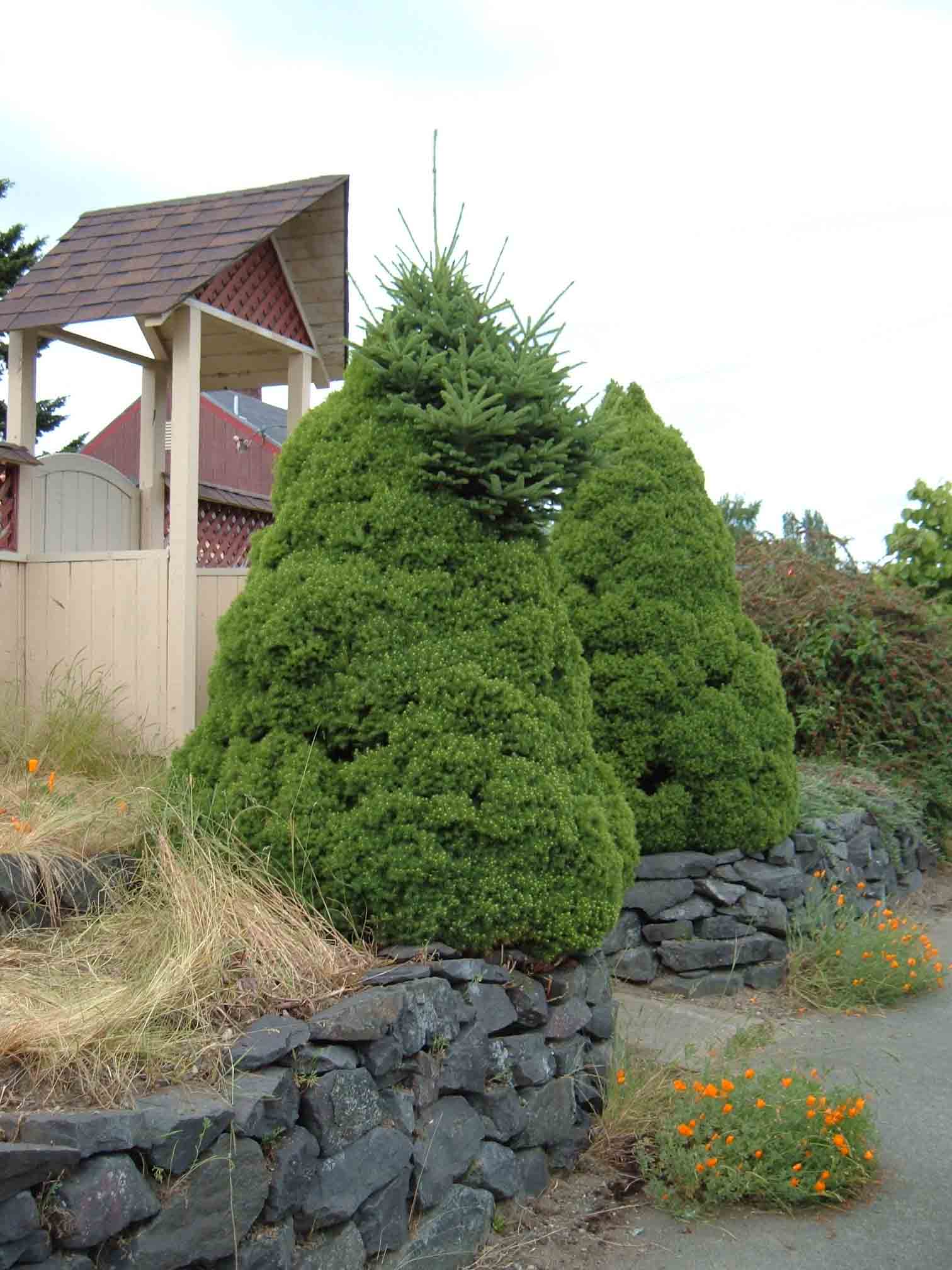
Thought we’d take a break from the invasive discussion (I have some throughts I’ll weigh in with on Mon.) In the meantime, here’s a photo of dwarf Alberta spruce not too far from my boyhood home in Olympia, WA. I get 2 or 3 of these calls each year; usually with a homehowner exclaiming, “I’ve got a tree growing out of my tree!”.