Every survivor has a story

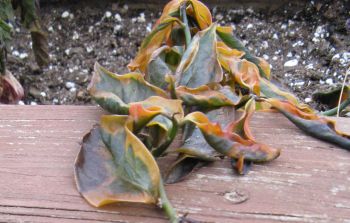
It’s been suggested, not unfairly, that the Garden Professors are sometimes a little ‘Tree-Centric’.  As a forester and tree physiologist by training, I’m probably the guiltiest among my co-conspirators on that count.  But occasionally I do notice things less than 10’ tall and lacking a single, woody trunk.


When weather permits I like to take my lunch down to the MSU annual trial gardens behind my office here at the Plant and Soil Science Building.  Every summer the annual gardens are awash with the color of impatiens, geraniums, petunias, and other annuals. … Continue reading this article “Every survivor has a story”

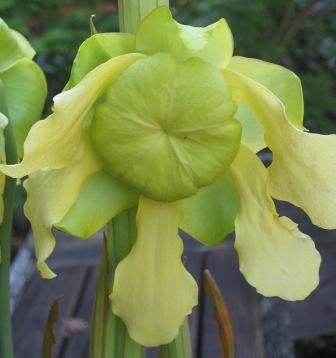
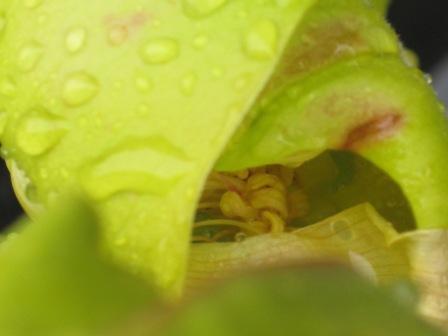
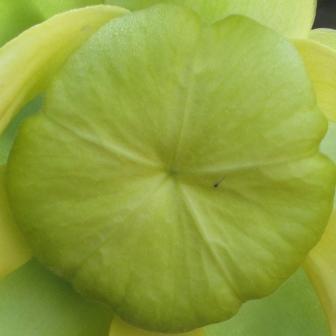
Friday’s “disk of mystery”

What is this "green disk of mystery?"  It’s about 2" in diameter:

Answer on Monday – have a great weekend!

The Approach Graft

Seeing as this blog is called “The Garden Professors” it has been far too long since we’ve given you a lecture on a useful practice for your garden, so this week I thought I’d give you a little how-to demonstration on something called approach grafting.  Approach grafting is a technique that you could use to graft a tomato to a tomato (good if you want to use a disease resistant root with a non-disease resistant top — common in heirloom tomatoes), a tomato stem to a potato root (just a fun project), or an eggplant root to a tomato shoot (good for wet locations).… Continue reading this article “The Approach Graft”

Permaculture – the discussion continues

We’ve started a robust discussion on the topic of permaculture, especially as applied to home gardens.  Let’s continue looking at some of the advice provided in Gaia’s Garden targeted towards home gardeners.

The book contains several lists of plants suggested for specific functions.  For brevity’s sake, I’ll just mention two:

“Host plants for Beneficial Insects” (pp. 157-159)
This list is prefaced in the text with “many of these florae are very attractive and can (and should!)… Continue reading this article “Permaculture – the discussion continues”

Visiting Professor guest post: Native wildflowers

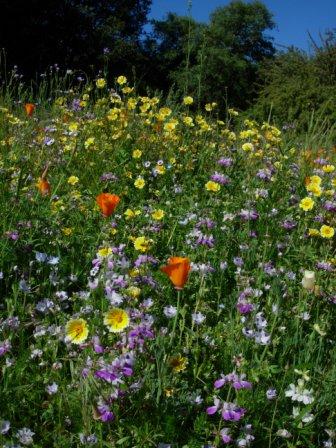
Recently I have been fascinated by the native wildflower field I planted last fall.  Although I seeded it with the same mixture of seeds (mixed with sand to spread them evenly), you can see that we have clumps of different flowers throughout the area.


Figure 1. Descanso Gardens, California

The area where the wildflowers were planted had several 1-2 foot raised mounds; some were in the shape of keyholes.  These were built with silty sand from a nearby seasonal stream that had some erosion problems in a rainy year.… Continue reading this article “Visiting Professor guest post: Native wildflowers”

Everything is obvious once somebody shows you…

It’s amazing how many things in life seem complex when we try to figure them out for ourselves but then we end up smacking ourselves on the forehead when someone shows us how simple it really is.  The infield fly rule comes to mind.  Some colleagues of mine here at Michigan State may be on their way to such a solution for the problem of white grubs in lawns.  Drs. Dave Smitley (Entomology), Kurt Steinke, and Trey Rogers (Crop and Soil Science) are investigating the effect of mower height on turf damage from grubs.… Continue reading this article “Everything is obvious once somebody shows you…”

Spruce brown-out solved

Gall adelgids are certainly a problem in these parts, especially on blue spruce.  But the ‘problem’ in this case is not a pest.  This year, as in several recent years, spruces are developing copious amounts of pollen cones.  Once the pollen is shed, the cones dry up and turn brown.  Many homeowners mistake these for insect galls or sign of some other pest activity.
In many conifers, pollen cones occur on the lower portion of the crown while seed cones occur in the upper third as an evolutionary adaptation to reduce selfing.
Continue reading this article “Spruce brown-out solved”

Friday Quiz: Spruce brown-out?

We’re beginning to see signs that we may be getting a lot of calls on spruces this year similar ones we experienced a couple of years ago.   Homeowners and landscapers are calling in with reports of brown ‘growths’ on spruces – particularly white spruce and some on Colorado blue spruce.  The growths can be quite noticeable, even from a distance and cause trees to take on a brownish cast; usually most prevalent on the lower 2/3rds or so of the crown. … Continue reading this article “Friday Quiz: Spruce brown-out?”

Some Super-Cool Stuff

For the past ten years or so I’ve worked to try to transfer information about horticulture to people.  It sounds simple, but it actually took a lot of time and effort to figure out the best way to do it, and I’m still not there yet — and probably never will be.  The reason that I mention this is because I appreciate it when another horticulturist, such as my fellow garden professors, work to get information about horticulture out to the public. … Continue reading this article “Some Super-Cool Stuff”

Permaculture – beginning a discussion

Among other things, part of my job involves reviewing educational materials for use in WSU’s Extension programs related to urban horticulture.  One of the books is “Gaia’s Garden: a guide to home-scale permaculture” (T. Hemenway).  It occurred to me that my review might also be of interest to our GP readers.

I’ve created a fairly extensive review and I will break it into separate posts over the next few weeks.  So let’s start the discussion off with a topic we already know is inflammatory:  invasive species. … Continue reading this article “Permaculture – beginning a discussion”