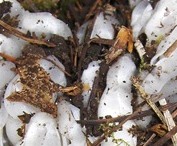
This week I received some photos of some mysterious white tubes emerging from a pile of lawn moss. Do you know what they are?
Answer Monday!
This week I received some photos of some mysterious white tubes emerging from a pile of lawn moss. Do you know what they are?
Answer Monday!
Friday’s “evil frog eye” was actually part of a voodoo lily (Dracunculus vulgaris), found growing in a drainage ditch in California (I’ve seen one in a drainage ditch in Seattle as well):
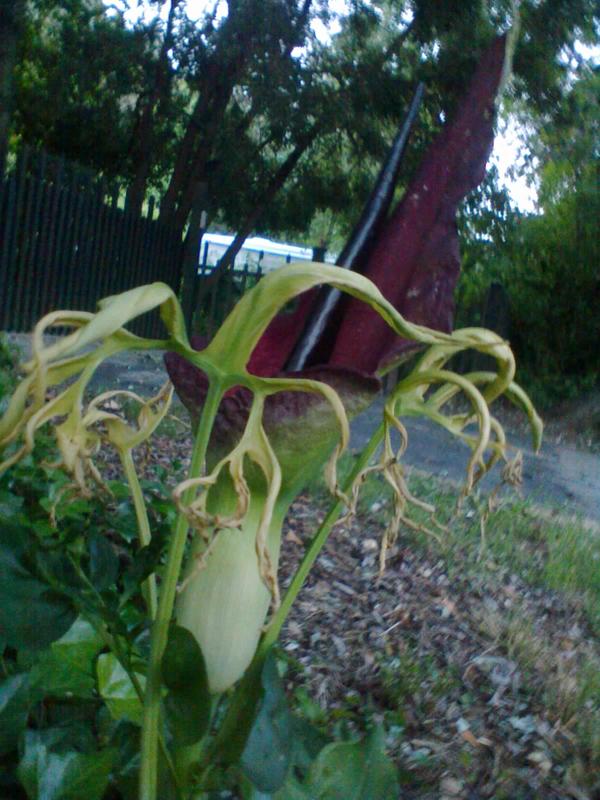
Obviously this introduced garden ornamental has escaped cultivation and is now “going rogue.” Will it become a nuisance weed? Will it displace native species? Should it be banned from sale by nurseries?
Sigh.
Just back from the national OFA Floriculture short course and trade show in Columbus, Ohio. There was quite a buzz (!) over the July cover story of the industry mag GrowerTalks:

Maybe, if there’s a variegated form…
GrowerTalks is NOT High Times. Commercial floriculture is a very, very conservative industry. Many family businesses. New petunia cultivars and seed-sowing technologies are the usual fodder for feature stories. But as a publication reaching out to people who grow plants under glass (or plastic) for a living, GrowerTalks has brought up a good point. … Continue reading this article “New Pot Crops”
Orchid fanciers Derek and Joseph correctly identified Friday’s mystery plant as a jewel orchid, specifically Macodes petola:
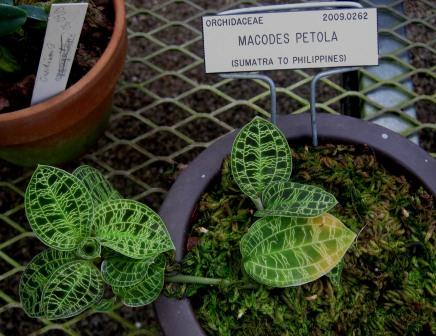
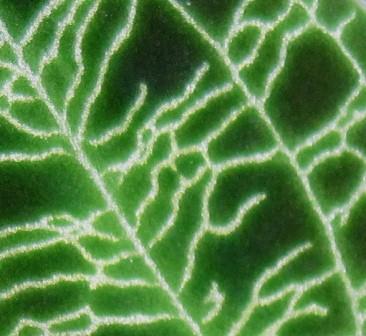
Friday’s sparkly leaf photo shows why “jewel orchid” is the common name used for several genera of orchids with showstopping foliage.
And Ray noted that Goodyera spp. (rattlesnake plantain) is a native US jewel orchid with beautiful variegated foliage. Next time you’re hiking in the woods, keep your eye out for this common yet striking plant.
What am I? (There has been no alteration of this photo, other than cropping, nor was it taken under any special lighting.)
Answer on Monday!
What is it?

Why, that’s a “Mace Sedge” – thus a medieval weapon AND a sedge. Actually…not very menacing. But very cute. Carex grayi is a wonderful clumping sedge, native to Eastern North America. Mine is situated at the edge of a home-made bog, and is at least 2.5′ tall with an upright habit.
More common in the trade are the cascading Asian sedges such as Carex dlichostachy ‘Kaga Nishiki’, C. oshimensis ‘Evergold’, and C. morrowii ‘Variagta’, all fabulous plants for the part-shade garden. … Continue reading this article “Grass, sedge, or weapon?”
I just got back from a 9 hour overseas flight, just in time to post the answer to last week’s quiz. So now you know…I wasn’t in the states. More on that later.
As many of you guessed, this is a fig tree (Ficus spp.) of some sort. I have horrendous taxonomic abilities anyway, but will cover my ignorance with the excuses that the tree wasn’t in flower, nor were there any signs in any of the little parks identifying the tree. … Continue reading this article “Quiz answers – more or less”
Paul, Joseph, Kandi and Derek are all, apparently, Puya fanciers. But! It’s not P. alpestris, but P. berteroana – a species whose flowers are more turquoise than sapphire:

Yeah, Kandi, check out those spines! Even taking pictures is deadly!
And Paul and Joseph were correct – the long green structures are sterile (they bear no flowers) and serve as bird perches. The nectar almost runs out of these flowers, and as the birds get a sugar fix their heads are covered in pollen.… Continue reading this article “Answers to blue flower quiz”
The university’s server was down for scheduled maintenance over the weekend and I missed getting this posted. So you have until next Friday to consider this interesting flower from the Berkeley Botanical Gardens:
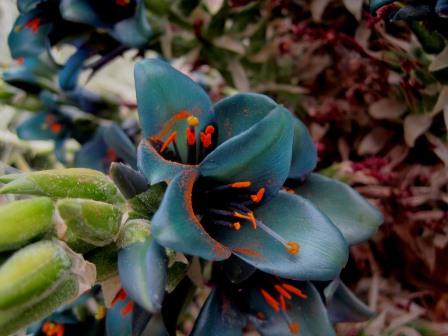
What is this plant?
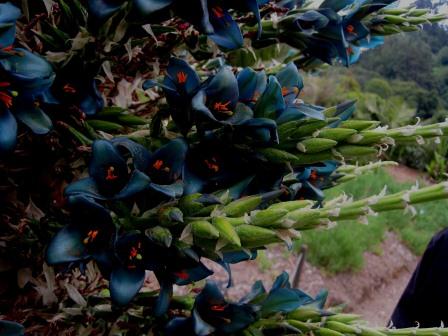
And what is the function of these long, green horizontal structures?
Have fun
Ed and Gayle correctly pointed out that short day plants (those that bloom in the spring or the fall) can sometimes do both. The asters probably experienced some transplant shock in the fall, which would have suspended floral bud development. This phenomenon could also be due to mild winter conditions (as Ed and Gayle also mentioned), which could have spared flower buds normally killed by freezing temperatures.
In any case, as spring daylengths approached those found in the fall, flower development continued and voila! … Continue reading this article “Solution to Friday’s flower fuddlement”