Friday puzzle solved – better late than never!

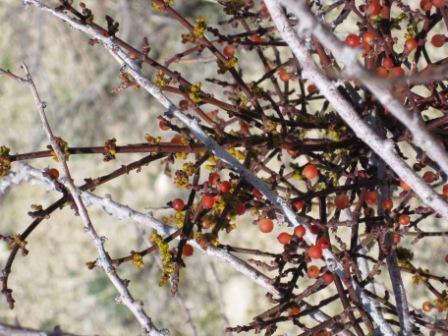
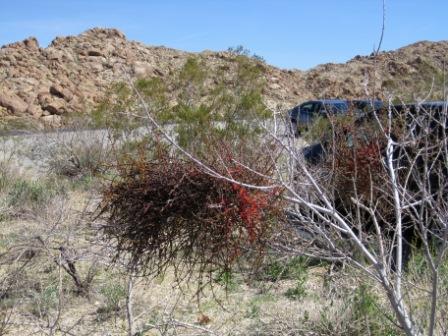
I spent yesterday flying from Seattle to Buffalo and didn’t get a chance to post the answer to the puzzle on Friday.  This was an easy one for our readers – the shrub is (was?) a mesquite, and the bushy growth in the photograph is mistletoe (as identified by Bob and seconded by Ginny and Jimbo). 

I am pretty sure this mesquite was dead, as it had been a wet spring and everything was leafing out. … Continue reading this article “Friday puzzle solved – better late than never!”
Friday plant puzzler – desert version

While looking over photos from my California desert trip this spring, I came upon this curious plant:

You can see most of the plant is dead (white branches), though there are two clumps of vigorous growth, shown up close here:

What’s going on here?

Answer Monday!

Morphology quiz answers

As Jason rightly guessed, this is a Schlumbergera species, specifically S. truncata, also known as the Thanksgiving cactus (which has toothed edges as shown). It’s related to the Christmas cactus (S. bridgesii – scalloped edges) and the Easter cactus (S. gaertneri, whose segments are three-sided rather than flattened). [Disclaimer: the nomenclature of this genus and its species is a mess. Even the university websites disagree on whether it’s Schlumbergera, Hatiora, or Rhipsalidopsis.… Continue reading this article “Morphology quiz answers”

Friday morphology quiz

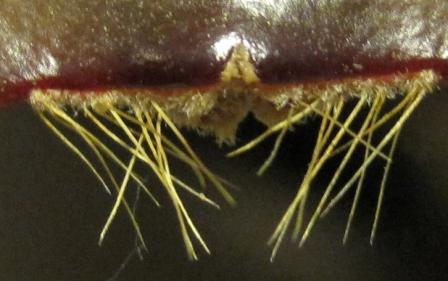
Take a look at this photo:

This is a two part quiz:  on what plant would you find these hairs, and what are these hairs called?

Answers on Monday!

Flower demystification

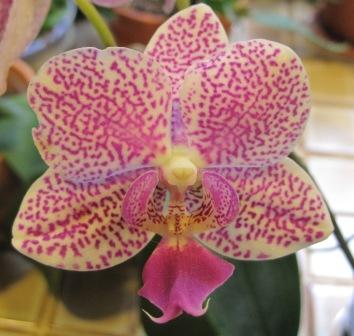
As Paul suspected, this is a Phalaenoposis flower.  Here it is again, shown next to another flower on the same plant (but different stalk):


As to the second question – why does it look this way – there could be a number of reasons.  I’m leaning toward environmental.  This particular flower stalk is an old one – after it had bloomed initially (with normal flowers), we left it on after the flowers fell.  As often happens, new flower buds appeared, but all of them have been abnormal. … Continue reading this article “Flower demystification”

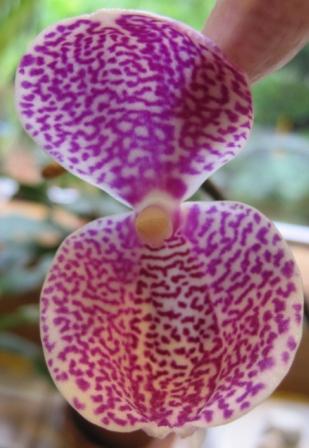
Friday puzzle – Mystery flower

What am I?  And why do I look like this?

Neither the flower nor photo has been altered.  But it is a tricky question.

Answer on Monday!

Friday puzzler unearthed!

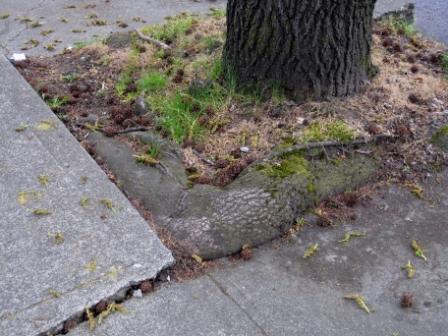
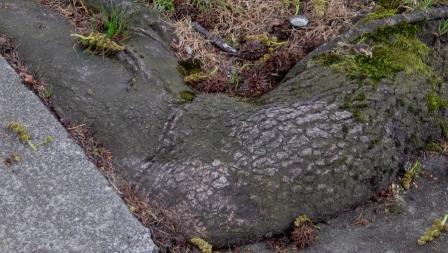
Lots of good guesses this week! As many of you realized, this is a huge tree root making the best of a small tree pit.  But it’s not a Norway maple (sorry John) or a mulberry (sorry Robert), but a sweetgum (Liquidambar styraciflua) (congratulations Brian!).  (You can see the little mace-like seed pods on the ground.)  The root does resemble a bicep (“Treebeard’s elbow”) flexing to crack the concrete (aka Robert’s  Concretious blandmulsia):

Though sweetgum can be nice urban trees, their roots are quite vigorous and can lift sidewalks several inches above grade as they increase in diameter:

>

Thanks for all the entries – our readers are smart and funny!

Short tree syndrome solved!

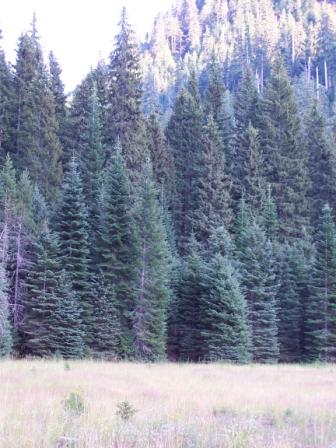
Good answers from Kenny S., Jimbo, Joe Schalk and Diana!  You were all skirting about the phenomenon of thigmomorphogenesis – or touch-induced change (also discussed in Jeff’s post of January 7.  The tests in the GP’s class are cumulative!).  In this case, the touch is wind.  Edge trees (or corn stalks) are more exposed and receive more wind, resulting in stunted heights and increased trunk diameter (you can’t see this last characteristic in the Friday photo). … Continue reading this article “Short tree syndrome solved!”

Friday quiz time

Here’s an interesting phenomenon you can see in any group of plants – it’s what we call the edge effect:

Today’s question:  why are the trees in the foreground so much shorter than those just a few feet farther from the edge?  Answer on Monday!