What am I? (There has been no alteration of this photo, other than cropping, nor was it taken under any special lighting.)
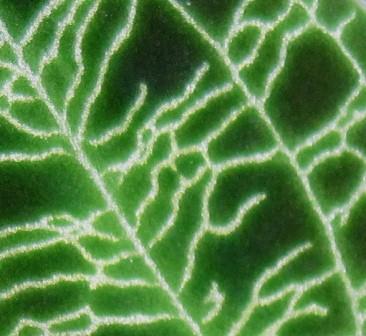
Answer on Monday!
What am I? (There has been no alteration of this photo, other than cropping, nor was it taken under any special lighting.)
Answer on Monday!
I’d turned Friday’s picture on end to try to fool you…but to no avail. Deirdre and Gail both guessed woodpeckers, and yes, this is sapsucker damage:
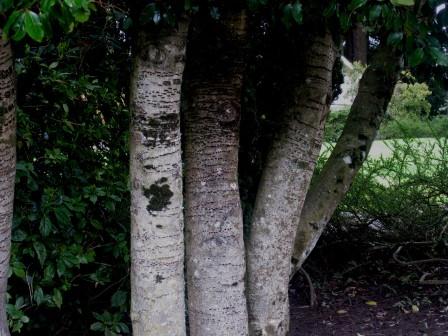
Though some woodpeckers look for insects under the bark, sapsuckers drill neat lines of wells that fill with sap. The birds can then move down the line of wells, lapping up sugar water. (Kind of the avian version of lining up tequilla shots on the bar.) Healthy trees are generally not at risk of dying from drilling injury, though if the tree is completely girdled that would be a problem. … Continue reading this article “Mystery pits revealed”
What am I?

Answer on Monday!
I just got back from a 9 hour overseas flight, just in time to post the answer to last week’s quiz. So now you know…I wasn’t in the states. More on that later.
As many of you guessed, this is a fig tree (Ficus spp.) of some sort. I have horrendous taxonomic abilities anyway, but will cover my ignorance with the excuses that the tree wasn’t in flower, nor were there any signs in any of the little parks identifying the tree. … Continue reading this article “Quiz answers – more or less”
I’m out of town this week, and taking lots of plant pictures. Here’s an interesting tree, quite common in the city where I’m staying:
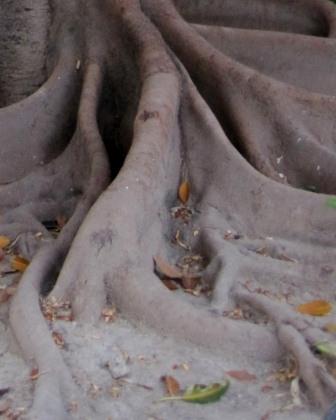
Question 1: What kind of tree is this? (Genus is good enough – species might be hard to tell.)
Question 2: In what geographical region might I be staying? (The tree is native as far as I know.)
Question 3: What are these woody structures called, and what function do they play?… Continue reading this article “Three part plant quiz”
Paul, Joseph, Kandi and Derek are all, apparently, Puya fanciers. But! It’s not P. alpestris, but P. berteroana – a species whose flowers are more turquoise than sapphire:
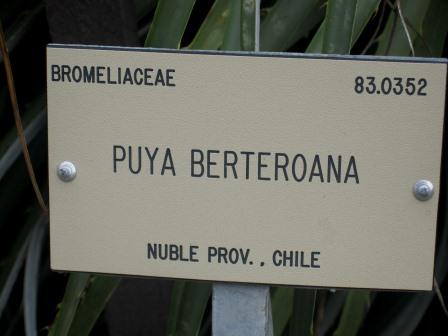
Yeah, Kandi, check out those spines! Even taking pictures is deadly!
And Paul and Joseph were correct – the long green structures are sterile (they bear no flowers) and serve as bird perches. The nectar almost runs out of these flowers, and as the birds get a sugar fix their heads are covered in pollen.… Continue reading this article “Answers to blue flower quiz”
The university’s server was down for scheduled maintenance over the weekend and I missed getting this posted. So you have until next Friday to consider this interesting flower from the Berkeley Botanical Gardens:
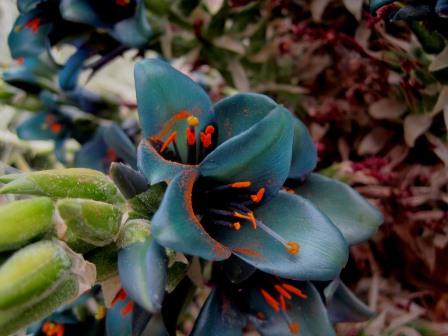
What is this plant?
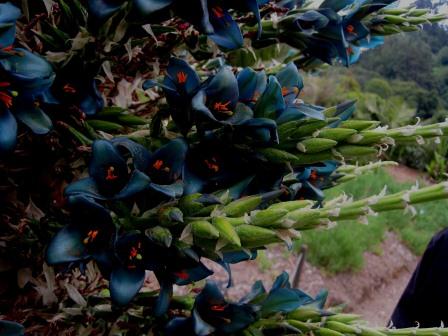
And what is the function of these long, green horizontal structures?
Have fun
Over at my favorite blog (besides this one of course!) Garden Rant, Amy Stewart posted about exploding watermelons — which Linda blogged about below — and about how Bt from genetically engineered food had found its way into our blood stream (and the bloodstream of unborn children). Sounds pretty scary doesn’t it? I’m not going to tell you it isn’t a little troubling, because it is, and I absolutely do not think this finding should be disregarded. … Continue reading this article “Bt in the Bloodstream!”
Last week a neighbor of mine called me up to ask how likely it was that their 4 year old (or so) crab apple tree was dead. Sometime over the course of the winter cute fuzzy bunnies had decided that the tree’s bark was tasty and decided to eat it. Naturally they ate it all the way around the circumference of the tree with the exception of a strip about an inch wide. At this point you’re probably asking yourself why the neighbors suspected the tree might be alive. … Continue reading this article “When Trees Don’t Know They’re Dead.”
Ed and Gayle correctly pointed out that short day plants (those that bloom in the spring or the fall) can sometimes do both. The asters probably experienced some transplant shock in the fall, which would have suspended floral bud development. This phenomenon could also be due to mild winter conditions (as Ed and Gayle also mentioned), which could have spared flower buds normally killed by freezing temperatures.
In any case, as spring daylengths approached those found in the fall, flower development continued and voila! … Continue reading this article “Solution to Friday’s flower fuddlement”