Friday quiz – yet more clematis calamity!

If you’ve been following the saga of our clematis, you’ll know that first they suffered iron toxicity (from the waterlogged soil they were in) and then were dug up and replanted in containers.  Last week I showed you what happens when you vigorously work wet soil – yet more waterlogging!  During the transplanting process, I took more pictures:
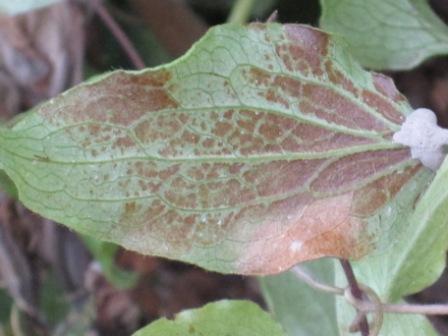
This damage is NOT from the iron toxicity problem.  It appeared during the transplant process.  What caused it?… Continue reading this article “Friday quiz – yet more clematis calamity!”
Lamb’s Ears Revisited

A bit more on my recent travels to the big floriculture conference in Columbus, Ohio.  I always try to make it out to the Chadwick Arboretum & Learning Gardens, on the campus of THE Ohio State University. There are several components, including trials, a large arboretum, and several small gardens.  My favorite is the Steven Still Perennial Garden. It’s a lovely mixed garden, designed by Adrian Bloom (Blooms of Bressingham), and was installed in ONE DAY by their garden volunteers – 2005, I think.… Continue reading this article “Lamb’s Ears Revisited”

Clematis conundrum clarified

Friday’s puzzle was tricky!  I will preface the answer by saying I don’t do a lot of container plants except for annuals.  When I plant up annuals into soilless potting mix (which is dehydrated), I work in the water thoroughly into this fluffy medium.  Friday’s situation was a little different.  The Clematis are more or less permanent residents in these planters, so I use real soil rather than potting mix.  (This will reduce or eliminate the shrinkage you’ll get if you use soilless media, as these highly organic materials steadily decompose.)… Continue reading this article “Clematis conundrum clarified”

Friday quiz – the tale of two clematis continues

A few weeks ago I showed you photos of iron toxicity in a Clematis planted in a soggy soil (perched water table).  Because this area is just not conducive to plants, we’re putting in a small deck.  This necessitated the excavation of two Clematis, which were both suffering from wet feet.  (Needless to say the root mass was very small and shallow on both plants.)  We decided to put them into large planters with conical trellises and use them as deck plants.… Continue reading this article “Friday quiz – the tale of two clematis continues”

What’s New?!

Just back from OFA – my discipline’s humongous tradeshow and conference in Columbus, Ohio. All things Floriculture – new perennials, annuals, and seasonal plants, technology, structures, and equipment for greenhouses, and plants and products for floral designers. The bulk of the show and educational sessions is focused on growers, but garden center owners and florists are also targeted.  I was part of two team talks for growers on “Perennial Production Problems and Solutions”.

Aside from the thousands of attendees and hundreds of exhibitors, it’s like a big family reunion for floriculture faculty involved in teaching, research, and Extension.… Continue reading this article “What’s New?!”

Tomato takedown

Well, Dr. Rohwer was right – he thought you’d get this more easily than I did!  Ray and Jon were spot on – this is classic juglone toxicity from those walnut trees (Juglans spp.) you see in the background.  Many of these leaves ended up on the roof, leaching into the rain barrels (good sleuthing Ray and KennyG!), the water in which was used in irrigating the vegetable garden.  In fact, Dr. Rohwer divulged that the rain barrel water was quite brown from the walnut leaves. … Continue reading this article “Tomato takedown”

A quiz – from our visiting professor

We’re glad to have Dr. Rohwer back for another visit!  Here’s his Friday quiz – see if you can figure out what happened to his tomatoes.

"Exhibit A is a tomato in our garden. We had 2 tomatoes last year a couple feet away from this one, they met the same fate. Wilting at about flowering time, and water did not resolve the wilting. Previous to last year, the area was turfgrass for who knows how long.… Continue reading this article “A quiz – from our visiting professor”

Propagating in the air

Most gardeners that I know have tried to produce roots on stem cuttings from plants that they like.  Sometimes this turns out well for them, particularly if they are working with what we call an easy-to-root species, and sometimes it turns out poorly.  OK, in all honesty, it often turns out poorly.  The problem is that plants like very particular conditions when they’re growing roots and the typical gardener is going to have a tough time providing these conditions. … Continue reading this article “Propagating in the air”

John Bartram Lives!

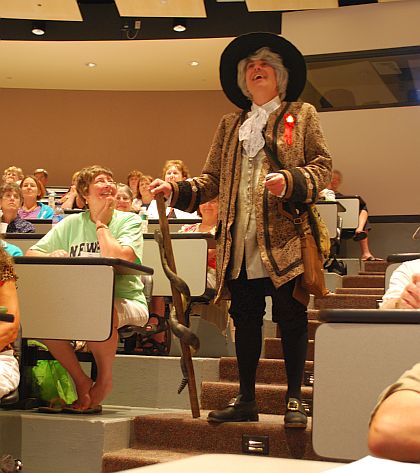
Yep, there he is. Showed up at our state Master Gardener College, just last week. I even went to dinner with him. The snake-on-a-stick startled the bartender just a bit.


The elder Bartram (his son William was also a great botanist and explorer) was the Royal Botanist to King George III and a member of the Royal Academy of Sciences, Stockholm. As with many of the Great Plant Explorers, his life combined botany with politics,
adventure, and lust [for plants,anyway].
Continue reading this article “John Bartram Lives!”

Clematis mystery solved

Friday’s quiz was a tough one. Bernadette and Lisa B. gave it a good shot, guessing that this might be a phosphorus deficiency. While they’re on the right track (it is a nutritional disorder), the mineral of interest is iron, and it’s a toxicity problem, not a deficiency.

Under wet conditions (the affected Clematis is in the part of our landscape with a perched water table – see the March 15 posting), iron is predominantly in the Fe+2 form (ferrous) rather than the Fe+3 form (ferric).… Continue reading this article “Clematis mystery solved”