What’s in YOUR honey? It may not be the nectar you expected.

This month’s National Geographic has a brief article from an ongoing study of the DNA profiles of urban honey. While we can all observe honeybees visiting flowers in our own gardens, until recently we could only assume what nectar they were collecting for honey production. This tantalizing snippet completely blew me away.

The study, undertaken by an entomologist who founded the Urban Beekeeping Laboratory and Bee Sanctuary, is sampling urban hives from major cities, including Boston, Portland (OR), New York, San Francisco, Seattle, and Washington DC.… Continue reading this article “What’s in YOUR honey? It may not be the nectar you expected.”

Our New Year’s Resolution – to keep you informed and entertained every week.

Happy New Year!

The Garden Professor’s collective resolution is to have at least one new blog post a week for 2018. So I’m kicking things off with a little fact checking on the claims made for a product that’s “a complete ecosystem in a bottle.” The company touts its strong connection to science (“our products revolve around biology”). There is a long list of ingredients and claims – way too much for one post. We’ll start with the first four this week.… Continue reading this article “Our New Year’s Resolution – to keep you informed and entertained every week.”

“Mulch Murder” Misinformation

This weekend I received a link to a Maryland gardening column with the intriguing title “Murder by Mulch.” My correspondent was concerned that her planned use of arborist wood chip mulch was going to cause problems. I assured her that it would not – but then spent some time looking at the column and putting it through CRAP analysis (credibility, relevance, accuracy, and purpose). It’s a skill that I encourage everyone – not just gardeners – to develop.… Continue reading this article ““Mulch Murder” Misinformation”

Rhymes with nārang

By Visiting Professors Dr. Charlie Rohwer and Ulrike Carlson

I’ve had this dream of doing a full academic etymological study of oranges, with the help of a second-cousin-by-marriage linguist and her historian husband. Being honest with myself, I know that’ll never happen. And also, honestly, they’d have to do all the work anyway.

But, the Garden Professor’s Facebook post about the citrus family tree revived my interest. Not for a full-blown academic analysis of the word ‘orange,’ but for a blog-friendly, factual, interesting post.… Continue reading this article “Rhymes with nārang”

Worst Gardening Advice – Video category

Here at the Garden Professors we try to focus on sharing the best applied plant and soil science information for gardens and landscapes. But sometimes we get sidetracked by information that is SO bad that we need to share it too. So the purpose of this occasional feature – Worst Gardening Advice – is not to poke fun, but to point out the real hazards to plants, people, and the environment by following scientifically unsound practices.… Continue reading this article “Worst Gardening Advice – Video category”

Dowsing for dollars

Recently I was at the Northwest Flower and Garden show and spoke to a gardener who was excited about some new information from his garden club meeting. Their speaker was a dowser – who promotes dowse gardening.

Now this was a new concept for me. I’ve heard of dowsing, of course, in the context of finding underground water. But dowse gardening?

Fortunately, my gardening friend shared his handout with me. I did a little Internet sleuthing and found the author, whose goal was to combine her two interests: dowsing and gardening.… Continue reading this article “Dowsing for dollars”

The Garden Professors rise again

It’s been over a year since I’ve posted to our blog.

I feel bad about that. But there’s always something else competing for my time, and the blog slipped away from the top of my “to do” list.

No more.

Today the federal government has clamped down on the ability of its scientists to communicate with the public. This is real – and it is frightening.

There’s not much I can do about that edict in my position as a state Extension specialist.… Continue reading this article “The Garden Professors rise again”

Buzz words are not evidence

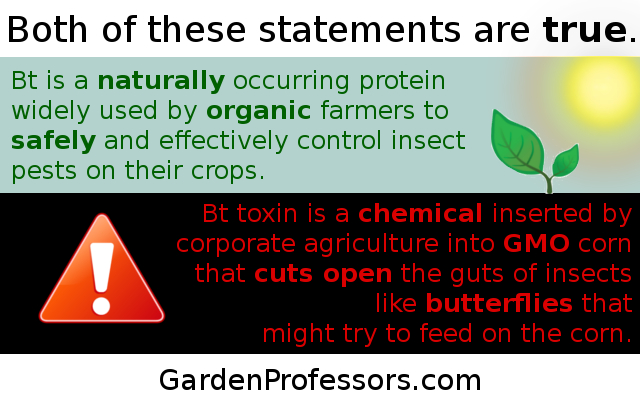
btimage

I made this little image to try and make a point, not about Bt or GMOs or organic agriculture (all important topics for another day), but about the use of buzz words. I’m tired of the way words like “chemical” and “natural” get thrown around to try and make things sound bad or good. Neither of them are particularly useful terms because the definition of chemical is so broad as to cover just about anything, and “Natural” is more-or-less meaningless and entirely subjective.… Continue reading this article “Buzz words are not evidence”

Fight the tyranny of spring!

Here in Michigan, spring is coming. Crocuses, snowdrops, and reticulata irises are in full bloom. Hepatica, forsythia, and daffodils will be coming on before long. Soon, garden centers and nurseries will be opening and gardeners driven mad by the long winter will rush out to buy every plant they can find with a flower on it. In the mad feed frenzy for flowers, we gardeners will sadly look over countless beautiful fall-flowering perennials and shrubs simply because they don’t happen to be doing their thing when we are shopping.… Continue reading this article “Fight the tyranny of spring!”

Rogues gallery

You know the word “rogue” as a noun and adjective, and probably from when Sarah Palin “went rogue” during her time as vice presidental candidate.

But you may not know that it also a verb. That’s the way I use it most often. I rogue plants and I complain — often — about seed producers not doing enough roguing.

To rogue means to weed out inferior or off-type plants. It is a critical part of producing and maintaining seed selections of plants.… Continue reading this article “Rogues gallery”