Take a look at this photo:
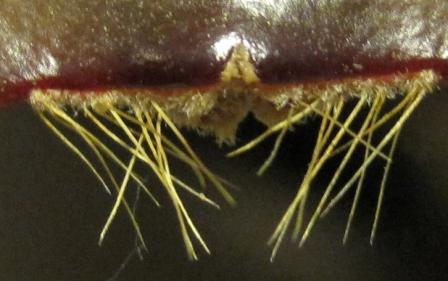
This is a two part quiz: on what plant would you find these hairs, and what are these hairs called?
Answers on Monday!
Take a look at this photo:
This is a two part quiz: on what plant would you find these hairs, and what are these hairs called?
Answers on Monday!
With increasing interest in reducing monocultural swaths of turf, summer water consumption, and the drudgery of mowing, many people are eliminating part or all of their lawns. We did this at home some years ago and can attest to the tangible benefit of reduced water bills during our dry summer months.
The question I often get is – how? Do you dig up the turf and throw it out, then fill in with topsoil? Or do you cut it, flip it, and then plant on top of it?… Continue reading this article “How to get rid of your lawn”
As Paul suspected, this is a Phalaenoposis flower. Here it is again, shown next to another flower on the same plant (but different stalk):
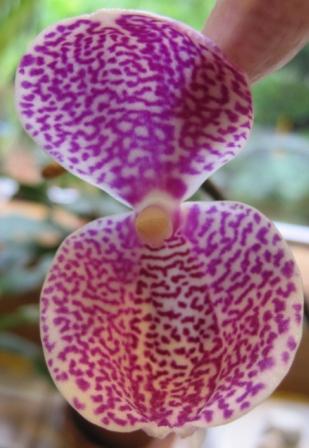
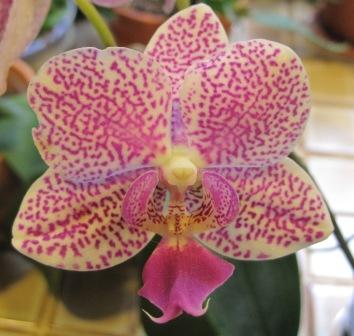
As to the second question – why does it look this way – there could be a number of reasons. I’m leaning toward environmental. This particular flower stalk is an old one – after it had bloomed initially (with normal flowers), we left it on after the flowers fell. As often happens, new flower buds appeared, but all of them have been abnormal. … Continue reading this article “Flower demystification”
What am I? And why do I look like this?
Neither the flower nor photo has been altered. But it is a tricky question.
Answer on Monday!
We’ve had some good, vigorous discussion about permaculture, specifically around the book Gaia’s Garden. I’ve pointed out some problems with the author’s understanding of relevant plant and soil sciences and will wrap up this week with a look at the glossary and bibliography.
Glossary
The glossary contains a number of scientific-sounding words and phrases with unscientific definitions; for example:
“Buffer plants: Plants placed between guilds or between allelopathic species. They should be compatible with the trees in each guild and should have a positive effect on one or both of the guilds to be linked.”… Continue reading this article “Permaculture – my final thoughts”
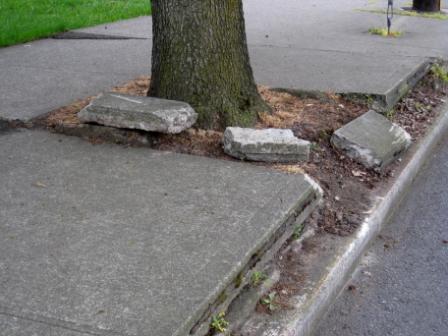
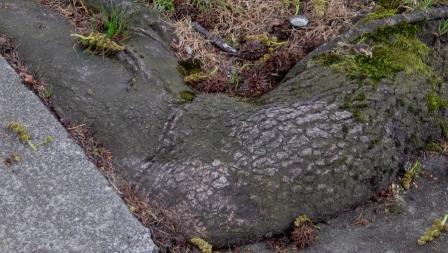
Lots of good guesses this week! As many of you realized, this is a huge tree root making the best of a small tree pit. But it’s not a Norway maple (sorry John) or a mulberry (sorry Robert), but a sweetgum (Liquidambar styraciflua) (congratulations Brian!). (You can see the little mace-like seed pods on the ground.) The root does resemble a bicep (“Treebeard’s elbow”) flexing to crack the concrete (aka Robert’s Concretious blandmulsia):
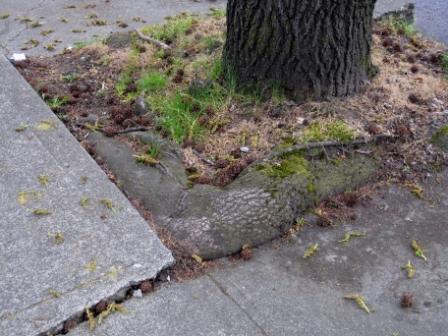
Though sweetgum can be nice urban trees, their roots are quite vigorous and can lift sidewalks several inches above grade as they increase in diameter:
>
Thanks for all the entries – our readers are smart and funny!
What am I? Lots of clues here…
Answer and more photos Monday!
As a member of the GWA (Garden Writers Association), I routinely get emails about new garden products. Here’s one I received this week:
“I thought your readers or listeners might be interested in learning of a new way to protect their plants without using pesticides. Moisturin, which contains no toxic ingredients, is sprayed on plants to form a clear flexible barrier strong enough to lock out both insects and airborne plant disease. Moisturin is inexpensive, easy to use and extremely effective. … Continue reading this article “Yet another fine product”
Good answers from Kenny S., Jimbo, Joe Schalk and Diana! You were all skirting about the phenomenon of thigmomorphogenesis – or touch-induced change (also discussed in Jeff’s post of January 7. The tests in the GP’s class are cumulative!). In this case, the touch is wind. Edge trees (or corn stalks) are more exposed and receive more wind, resulting in stunted heights and increased trunk diameter (you can’t see this last characteristic in the Friday photo). … Continue reading this article “Short tree syndrome solved!”
Here’s an interesting phenomenon you can see in any group of plants – it’s what we call the edge effect:
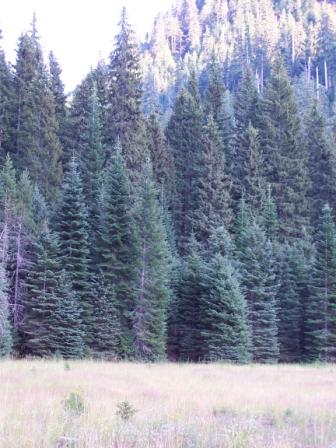
Today’s question: why are the trees in the foreground so much shorter than those just a few feet farther from the edge? Answer on Monday!