As we head into Fall garden routines and leaves start to turn color, the smell and feel of the Fall weather is in the air. Winter is just around the corner and with those horticultural routines comes the urge to prune stuff . Both fruit producing and shade producing trees often get a hair cut during fall and winter months, herbaceous perennials are often cut back in the fall after bloom and before their winter rest so it seems a good time to blog about pruning before you get the urge! … Continue reading this article “Pruning Basics”
Author: Jim Downer
Dr. Downer has 34 years of experience as a horticulture and plant pathology Advisor with the University of California Cooperative Extension in Ventura County. Dr. Downer’s academic training is from California Polytechnic Univ., Pomona, (BSc. horticulture & botany, 1981; MSc. Biology, 1983;. In 1998 he earned a Ph.D. in plant pathology, from University of California, Riverside. Dr. Downer’s research is focused on mulch, soil microbiology and disease suppression in mulched soils, diseases of shade trees and cultural practices to maintain landscape plants. Dr. Downer is a member of the American Society of Horticultural Science, the American Phytopathological Society, The International Soc. of Arboriculture, and the Western Chapter of the ISA, and the International Society for Horticultural Science. Dr. Downer is an Adjunct professor at California Polytechnic University in Pomona. Dr. Downer serves on the Board of the John Britton Fund for tree Research as the chair of the research advisory committee, and currently chairs the regional conference committee for WCISA. Dr. Downer has a love of shade trees, Shinrin roku (forest bathing/walking) tree work, wood working, horses, gardening, horticulture and the study of plants and their biology.
Diagnosing Abiotic Disorders II
In this blog I continue to examine maladies caused by environmental conditions in the absence of a disease agent or insect.
Salinity
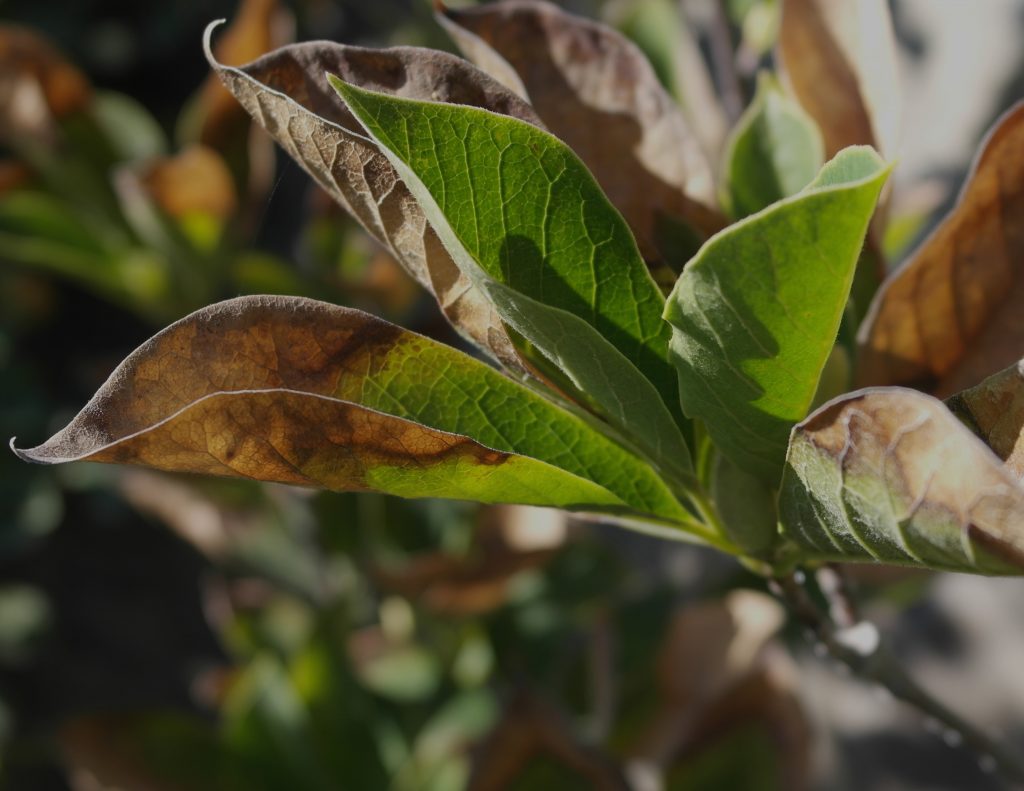
Salt in soils or water is simply the presence of too many soluble ions in the soil-water solution. This tends to happen in dry climates where evaporation rates exceed precipitation rates. In these climates salts accumulate in soil when surface waters pick up minerals from soil that is high in precipitated salts.… Continue reading this article “Diagnosing Abiotic Disorders II”
Diagnosing Abiotic Disorders I

Insects and pathogens cause damage and disease in garden plants, but damage can also occur in absence of pests. We refer to these diseases as abiotic disorders. Plant pathologists consider abiotic disorders diseases because plants develop symptoms that reflect the changes in their physiology over time.… Continue reading this article “Diagnosing Abiotic Disorders I”
Is your landscape “Sustainable”?
The word “sustainable” gained new life over the last few decades as the concepts of sustainable agriculture and now sustainable landscapes were developed. But what actually are “sustainable” landscapes? This is not something that is easily defined, so I offer my own ideas on the subject here. We can think about this and be thoughtful about landscapes and garden choices as we grow, plant, and maintain landscapes at home and in public spaces.

My Soil Is Crap, Part II
Last month in my blog My Soil Is Crap Part I, I tried to dispel the myth that you can diagnose soil problems by just looking at your soil. While the color of a soil does impart some diagnostic qualities, most soils are not easily analyzed without a soils test. A complete soils test will give a textural analysis including useful information about water holding capacity and a variety of chemical analyses. Soil reaction or pH is an essential component of any soil test (and is often unreliable in home soil test kits).… Continue reading this article “My Soil Is Crap, Part II”
My Soil is Crap
My Soil is Crap! Or is it?
Over several years of teaching basic soil science to arborists, master gardeners and students something started to coalesce into a trend. If I ask my students do they have “good” soil, many say no. I have heard Master Gardeners complain their soil is terrible or that a certain soil is bad in some way. People form opinions about soil based on its color, texture, odor, or even how plants grow in it (perhaps the most diagnostic quality).… Continue reading this article “My Soil is Crap”
The contrarian rosarian–debunking rose mythology
Roses are perhaps the most frequently cultivated landscape plant across America. Rose gardens are common to parks, landscapes, botanical gardens and for homeowners. Everyone seems to have an opinion about rose culture and there are numerous clubs and societies to support the hobby of rose growing. This week I am in the midst of pruning my rose fertilizer study here in Santa Paula California. I have 240 roses of eight varieties and my thoughts are on roses now, so I offer this blog to dispel some of the myths about rose horticulture.… Continue reading this article “The contrarian rosarian–debunking rose mythology”
Why Fresh is Best—when it comes to mulch?
One of the most misunderstood gardening practices is mulching. There is much mulch misinformation in horticulture books, web pages and even extension leaflets. First,what is Mulch? Mulch is any substance the covers the soil surface. Mulch can be inorganic (rock), hydrocarbon (plastic) or carbon based (chips, bark etc.) While any material applied to the soil surface could be considered mulch, the benefits of mulching especially to woody plants are greatest from fresh woody chippings of tree trimmings–so called “arborist chips” applied fresh—not composted.… Continue reading this article “Why Fresh is Best—when it comes to mulch?”
Pruning Paints Debunked
When my turn comes up to blog for the Garden Professor site I like to reflect on the horticulture in my own gardens and orchard. Right now I am focused on pruning my old apple and stone fruit orchard. It has suffered bear attacks, drought, and mismanagement before we arrived in 2018. The previous owners were very aware of the need to treat pruning cuts large and small. The remnants of tree wound dressings are found all through our orchard and range from white latex paint to silicone caulk.… Continue reading this article “Pruning Paints Debunked”
The worms crawl in and the worms crawl out but these worms kill your plants
Our first major frost hit my part of Arizona a month ago, killing all tomato vines. I did my thanksgiving cleanup chores–removed all the vines and ground them into mulch. I noticed an ominous symptom on one a few of the heirloom varieties (Prudence Purple) that I removed—galled roots. This symptom when seen on tomato is evidence of Root Knot Nematode (RKN). More about RKN shortly. Nematodes are non-segmented worms, mostly free living in soil and feed on bacteria, fungi, small animals or each other.… Continue reading this article “The worms crawl in and the worms crawl out but these worms kill your plants”