Recently I was asked to comment about a rash of e-mails floating around cyber-space concerning the toxicity to dogs of mulch made from crushed cocoa bean hulls. Cocoa mulch is by-product of cocoa production. The dark brown mulch is aesthetically and aromatically pleasing, giving the garden a rich, chocolately scent. Since theobromine, a naturally occurring compound in chocolate is toxic to dogs, the internet is now filled with cyber-legends of dogs eating cocoa mulch and keeling over dead.… Continue reading this article “Will cocoa mulch kill my dog?”
Author: Bert Cregg
The World According to Chub
Following up on Holly’s theme of “I can’t believe I get paid to do this”, last Wednesday I participated in a walk-through and inspection of the Justin ‘Chub’ Harper Collection of Dwarf and Rare conifers at MSU’s Hidden Lake Gardens in south central Michigan. The Harper collection is widely regarded as one of the premier collections of rare and unusual conifers in the world.
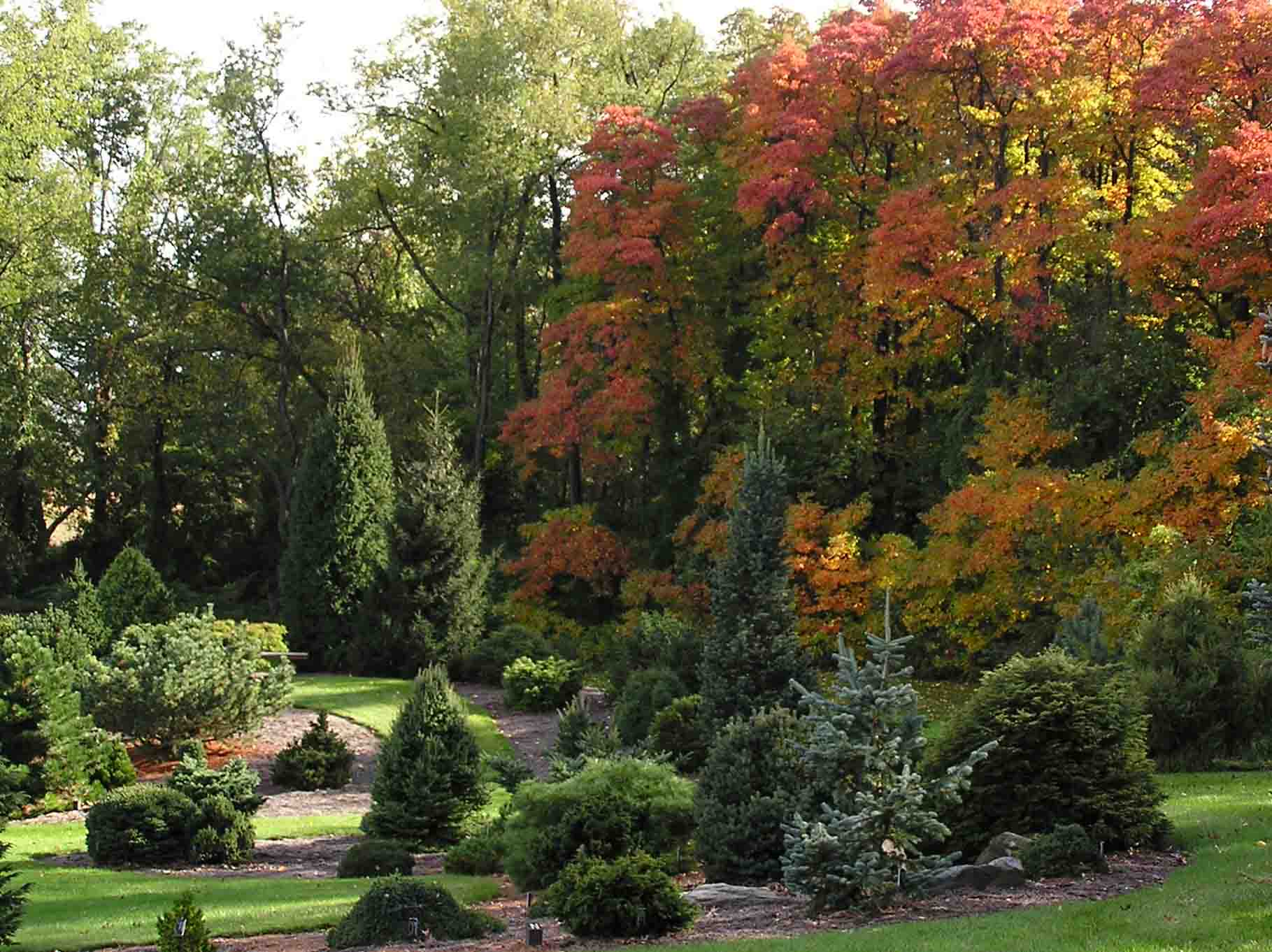
Harper Conifer Collection with fall color background. Photo: Jack Wikle.
A little background: Chub Harper was the former grounds supervisor for John Deere’s world headquarters in Moline, IL, an avid plant collector, and a founding member of the American Conifer Society (ACS). … Continue reading this article “The World According to Chub”
Carrot-top syndrome in white pine
I know a few folks out there are starting to believe that I’m just an apologist for the nursery industry. While it’s true most of the nursery people with whom I work are hard-working folks trying to do their best to run a successful business and produce a quality crop, there are certainly some issues out there and I’ve got my share of pet peeves. One of the things really that chafes my heiney is what I refer to as “Carrot-top” syndrome in eastern white pine (Pinus strobus). … Continue reading this article “Carrot-top syndrome in white pine”
Should I boycott cypress mulch?
It’s hard to think of mulch as a controversial topic but, as with most things these days, we find people on both sides of an issue. And, as with most things these days, some of opinions are based on substance, others are not. In the southern U.S. some environmental groups are advocating a boycott of cypress mulch.
Cypress mulch is derived from baldcypress and pond cypress, which grow in ecologically sensitive wetlands in the Southeast. Cypress wood is highly valued for is natural decay resistance. … Continue reading this article “Should I boycott cypress mulch?”
The Flap Over Burlap
This month’s issue of the Oregon Association of Nursery’s Digger magazine includes the second part of a two-part article on urban foresters’ perspectives on nursery stock. It was interesting to note that some urban foresters felt they were in a quandary because their specs require removal of burlap from B&B trees, yet many nurseries will void their warranty if burlap is removed from the root ball.
Removing burlap from B&B trees is a practice that is widely recommended, yet there is little, if any, data to support it. … Continue reading this article “The Flap Over Burlap”
EverGreen or EverYellow?
In last week’s post I mentioned that many tree problems can be difficult to diagnose and require a thorough inspection and site analysis to get to the root of the problem. In contrast, a recent issue that has generated a lot of calls is easy to explain and is not a cause for major concern. Many homeowners and others are alarmed that needles on their white pines are turning bright yellow.
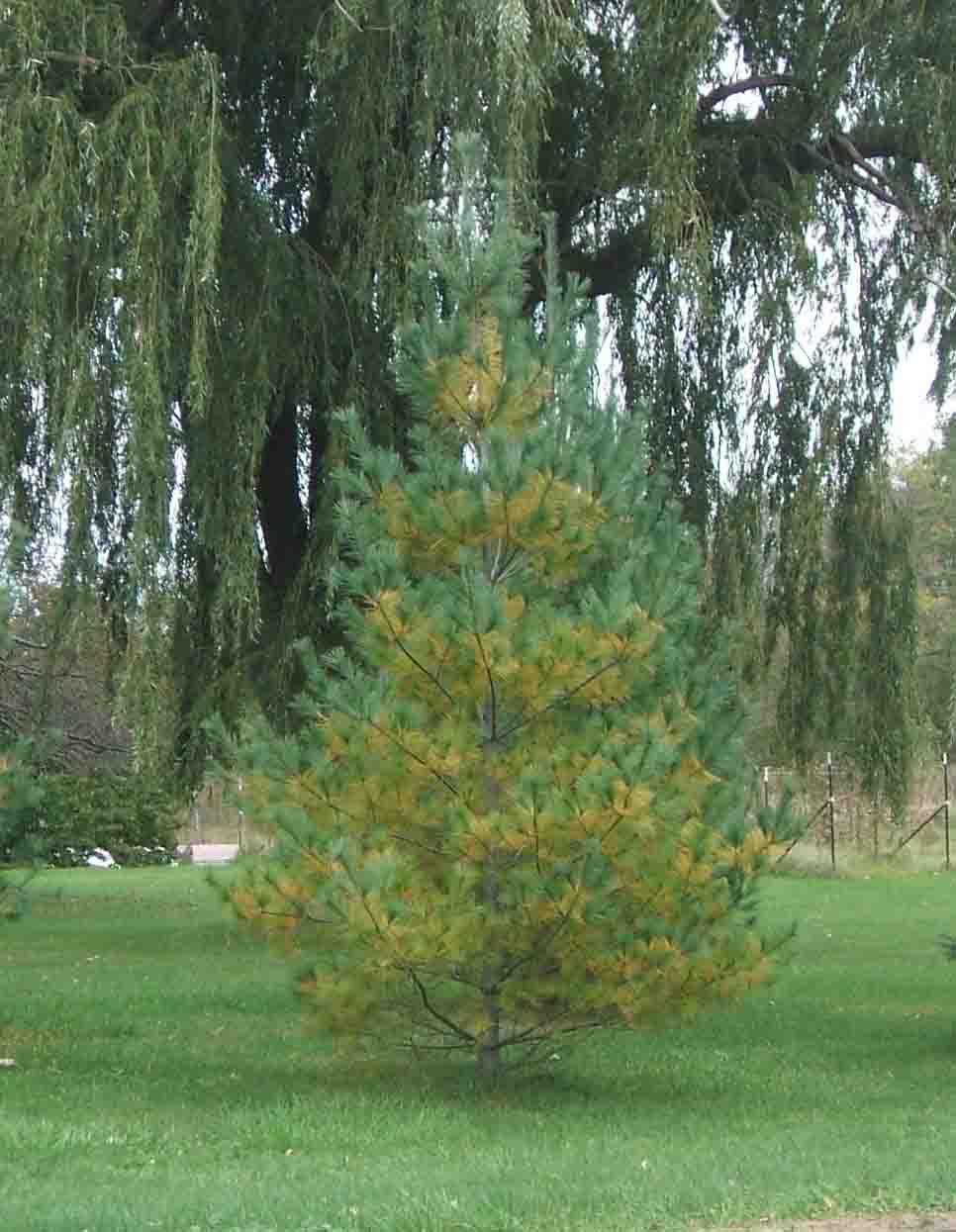
“Is my pine dying?”
The key in assessing this situation is looking at which needles are turning color. … Continue reading this article “EverGreen or EverYellow?”
Support your local arborist
A couple of weeks ago I was interviewed for the local paper about this year’s fall color. It’s pretty standard fare around these parts; newspapers, AAA, and so on want to know if we’re going to have good fall color, will it be early, will it last long. I mentioned to the reporter that we’re seeing a lot of early fall color in the maples around mid-Michigan, in contrast to the northern part of the state, which appears to be running a little late. … Continue reading this article “Support your local arborist”
Baring it all, again.
Earlier in this blog we had a rather robust discussion about the merits of transplanting trees bare-root. Bare-root transplanting has had a renaissance in arboricultural circles, based in large part on the work of Dr. Nina Bassuk and her colleagues at the Urban Horticulture Institute at Cornell.
As our bloggers noted, transplanting trees bare-root has advantages over balled and burlap trees (larger portion of the root system stays with the tree) and over container-grown trees (more natural root system development). … Continue reading this article “Baring it all, again.”
Shoot your favorite ash
One of the biggest issues facing urban and community forestry in the eastern half of North America is the Emerald Ash Borer (EAB). As most people are aware, EAB was accidentally introduced in Michigan some time in the late 1990’s. By 2002 when the insect was found and identified, thousands of ash trees in and around Detroit were dead or dying. Since then the insect has continued to spread, partly by natural dispersal but also by hitchhiking on logs and firewood.… Continue reading this article “Shoot your favorite ash”
Another look at TreeGators
Following up on Linda’s earlier comments about potential problems with TreeGators, my summer interns and I did a random spot check of about 150 TreeGators currently in use on the MSU campus. As background, MSU Landscape Services plants about 1,200 trees and shrubs each year. All newly-planted trees which are not on an automatic irrigation system are fitted with one or two TreeGators, which are filled from a water wagon every week or every two weeks, depending on weather. … Continue reading this article “Another look at TreeGators”