Thoughts on reproducibility and reliability in science

You’ve probably heard about a project that attempted the replicate 98 psychological studies and found that only a third of them were reproducible, the other two thirds produced different results – sometimes very different, more often only somewhat so.

Though psychology was the subject of this study, you shouldn’t assume the results were unique to that particular field. The are plenty of reports of similar failings and the so-called ‘Decline effect’ in other scientific disciplines.

So why is that?… Continue reading this article “Thoughts on reproducibility and reliability in science”

Another unnecessary tree failure

The end of August brought an unseasonable rain- and windstorm to the Puget Sound region. We had some spectacular tree failures which I missed seeing as I was out of town. But one of our Facebook group members, Grace Hensley, was on the ball and took some great photos of a fallen purple-leafed plum. The first thing you see is the complete lack of a stabilizing root system.

Now look at the base of the trunk, which is actually a massive circling root that has girdled the trunk over time.… Continue reading this article “Another unnecessary tree failure”

Ray’s 2015 Tomatoes

I thought I’d share some of the new varieties of tomatoes I’m growing this year, along with some old favorites.

First up is a picture of a new variety from Dr. Harry Klee’s research at the U. of Florida called Garden Gem, along with Blush from Artisan Seeds.

Garden Gem is a new hybrid, poised to take the fresh market grocery store tomatoes on. Same disease resistance, same shipping quality, but with much improved flavor. … Continue reading this article “Ray’s 2015 Tomatoes”

Don’t just stand there like a statue

Posted by Bert Cregg


Reading through Linda’s recent article in Arboriculture and Urban Forestry “Nonnative, Noninvasive Woody Species Can Enhance Urban Landscape Biodiversity” (Arb. & UF 41:173-186) reminded me of some thoughts I had while I sat through a talk by Doug Tallamy at the New England GROWS conference back in February.  As most GP blog readers are likely aware, Tallamy is the author of Bringing Nature Home.  The basic premise of the book is that native insects only feed on native plants and therefore the use of exotic landscape plants will cause ecological food webs to collapse and the end of the world as we know it.… Continue reading this article “Don’t just stand there like a statue”

Where double flowers come from (sometimes)

Doubling of flowers — the development of extra petals — is a common mutation, and often beloved by gardeners. Sometimes double forms of flowers become so popular that gardeners hardly recognize the single flowered, wild-type. Wild roses, for example, have just 5 (or, in once case, 4) petals and look totally different than the extra petal flaunting varieties familiar from gardens.

Doubling usually happens when gene expression gets mixed up and bits of cells that were destined to develop into anthers develop into extra petals instead.… Continue reading this article “Where double flowers come from (sometimes)”

Master Gardeners are Great, And They Deserve Better

If you’re looking for cat videos, birthday reminders, and a method for spying on old friends then Facebook is pretty useful, but for cold hard facts?

Not so much.

Well, actually we’re overstepping here. It’s really not Facebook. After all, Facebook is kind of like a blank sheet of paper. The paper doesn’t tell the truth or lies, it’s the person who writes on the paper. On the Garden Professor’s Facebook page we do a pretty good job of offering science based information to people.… Continue reading this article “Master Gardeners are Great, And They Deserve Better”

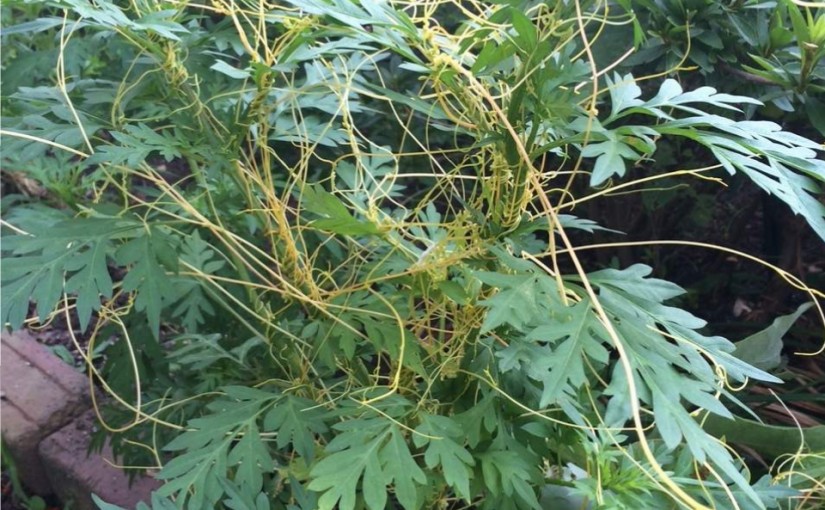
When Plants Attack! (each other)

When you talk about killer plants, your mind may conjure images of a man-eating plant in “Little Shop of Horrors,” insect-eating Venus flytraps or poisonous plants like deadly nightshade.

While all of those scenarios are interesting in and of themselves, what about plants that attack other plants?

I’m talking, of course, about parasitic plants. These plants thrive on stealing nutrients from other plants, either weakening them or, quite possibly, killing them.

Parasitic plants connect themselves to a host plant and siphon off the sugars that plant produces and the nutrients it pulls from the soil.… Continue reading this article “When Plants Attack! (each other)”

It’s the Next Best Thing Since Draft Beer: New Plants and Their Proper Evaluation

With many new nursery catalogs arriving in my mailbox at work for 2016 introductions, I thought I would focus this blog on “new” plants. With all the publicity and marketing that goes on for new plant introductions, you would think that they are the next best thing since draft beer or even bread! I am a bit cynical and question whether these new plants really live up to their performance expectations and ornamental attributes. With so many new hydrangeas, coneflowers, coralbells, spireas, etc.… Continue reading this article “It’s the Next Best Thing Since Draft Beer: New Plants and Their Proper Evaluation”

When half a flower is the wrong color…

If you’ve spent enough time around flowers, you’ve probably seen this. It isn’t exactly common, but it happens, and is so distinctive that you’ll almost always notice when it happens, as I did on one of my gladiolus the other day.

sectoralchimera

Everything else is as normal, but a chunk of the flower is white instead of the usual soft peachy white.

What we have here is a sectorial chimera. Chimera means an organism with two (or more, I suppose) genetically different cell types, and a sectorial chimera is when there is one distinct section of the plant made up of a different cell type.… Continue reading this article “When half a flower is the wrong color…”

Scientific Beekeeping

When I first moved to the country in the late nineties, one of the first things I wanted to do (after establishing several vegetable gardens to indulge my tomato obsession) was to become a beekeeper.

So I took a six week course sponsored by West Virginia University, read the full documentation available from the University of Maryland and Penn State as well as back issues of beekeeping magazines, and checked with some hobby beekeepers in the area.… Continue reading this article “Scientific Beekeeping”