Hangin’ with the conifer cognoscenti…

Just a little bit of show and tell today.  The week before last the Central Region of the American Conifer Society (ACS) hosted the National ACS meeting here in Michigan.  Over 300 conferites gathered to discuss their favorite plants and share their conifer addiction.

The highlight of the meeting was a field trip to the Harper Collection of Rare and Dwarf Conifers at Michigan State University’s Hidden Lake Gardens.  The Harper collection, which was donated to MSU by noted plantsman Justin ‘Chub’ Harper is a world-class assemblage of conifers and includes over 550 plants displayed in a wonderfully-designed layout.… Continue reading this article “Hangin’ with the conifer cognoscenti…”
Blood in the water…

In prepping grad students for their first big talk at a scientific meeting I always tell them everything will be fine – until the first data slide hits the screen.  The audience will nod knowingly during the introductory comments and even during the materials and methods, but data charts and tables are to scientists what chum is to hungry sharks.  So clearly I should have known better than to post figures without error bars in last week’s post. … Continue reading this article “Blood in the water…”

Demonstrating Diversity

As I noted a few posts back, this summer marks the 10th anniversary of the discovery of emerald ash borer (EAB) in southeast Michigan.  While a lot of progress has been made on many fronts in the battle against EAB, the outlook for ash trees in North America still looks bleak for the foreseeable future.  Ash trees, both green and white ash, were popular choices as street and landscape trees throughout the Midwest and elsewhere. … Continue reading this article “Demonstrating Diversity”

Making hay while the sun shines

If you live anywhere east of Montana you know that two-thirds of the country has been roasting under record heat for the past few weeks.  While the weather has been a bane to farmers and many others, it has provided us with an ideal set of conditions to begin to look at the responses in the SoMeDedTREES project. 

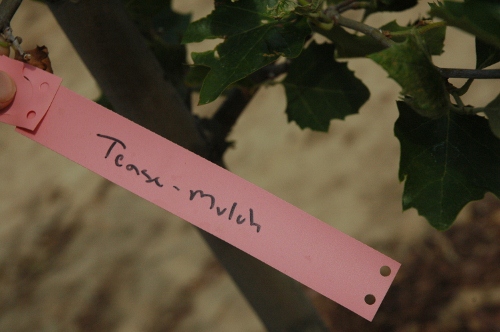
To recap, we installed two experiments with 25-gallon container-grown ‘Bloodgood’ planetrees.  In both experiments we applied one of three treatments to the root systems at planting: 1) “Shaved” the outer  portion of the root system to remove  circling roots, 2) “Teased” apart the outer portion of the rootball to remove circling roots and 3) “Control” where we did nothing to the root system, or “Pop and drop” to use Linda’s terminology. … Continue reading this article “Making hay while the sun shines”

A rose by any other name…

Many blue spruce trees in our area are suffering from a progressive decline.  This is more than the usual combination cytospora canker & rhizospaera needlecast that tend to make most mature blue spruce look crappy.   The current syndrome has been linked to phomopsis blight and affected trees show increasing branch die-back and in some cases trees go from a having a few dead branches to completely dead in a 3-4 years.  Because of this alarming and pervasive issue, I’ve been asked to put together a list of alternative selections for blue spruce as part of my extension duties.Continue reading this article “A rose by any other name…”

Ten years of life with the Green Menace: Part 2

Posted by Sara Tanis and Bert Cregg

NOTE: Last week I gave an update on the 10-year anniversary of the discovery of the emerald ash borer in the U.S.  In response to the post, Sonia John raised a couple of points:

“Please share your knowledge about the status of efforts to: 1. introduce insect species or other biocontrols that predate the EAB, and 2. evaluation of the degree of resistance to EAB of Asian (and European) Fraxinus spp.Continue reading this article “Ten years of life with the Green Menace: Part 2”

Ten years of life with the Green Menace

This summer marks an anniversary of sorts.  Shortly after I joined the faculty at Michigan State University in the fall of 1999 MSU Extension began to get reports of dead and declining ash trees in and around Detroit.  Since ash trees had relatively few serious pest issues and none that routinely caused mortality, the mysterious ash decline was attributed to cumulative environmental stresses, ash yellows or various site factors.  In the summer of 2002, however, a little-known exotic beetle from Asia, emerald ash borer (Agrilis planipennis) was identified as the causal organism.… Continue reading this article “Ten years of life with the Green Menace”

How open-minded are you? No, really.

Admitting you’re wrong is difficult.   For exhibit A see the recent discussion between me and Jeff over alternative nursery containers.  We all like to think we’re open-minded but  when push comes to shove we all end up like the Fonz on Happy Days when it comes time to say ‘I was wrrrrr… I was wrrrr….  I was not exactly right.”  http://www.youtube.com/watch?v=uwkU8-d1gIk   As scientists we’re supposed to be objective and base our judgments on verifiable data and careful and repeatable observations.… Continue reading this article “How open-minded are you? No, really.”

A Horticultural Tour of Washington DC

My wife and I were in Washington DC a few weeks back for a wedding.  I’ve been to DC a handful of times and it is one of my all-time favorite places to visit.  I love history so the memorials, monuments and Smithsonian museums are all high on my list.  But DC has a lot to offer plant geeks as well.  In honor of Memorial Day and the unofficial start of summer vacation season, here are my top three DC Horticultural Highlights.… Continue reading this article “A Horticultural Tour of Washington DC”

Research in real time

It’s been a busy spring around the Cregg lab.  In many ways, it feels more like mid-summer than mid-May.  One of the items my students and I have been with is installation of the Social Media Designed Tree Transplant Study (SoMeDedTreeS).  As loyal Garden Professor blog readers will recall, we conducted a Survey Monkey poll last fall to help develop a study plan to investigate tree transplanting practices of container-grown trees.  Based on the results of the survey we designed a study to look the effects of root-ball manipulation and post-transplant fertilization on 96 planetrees.… Continue reading this article “Research in real time”