by Hamutahl Cohen
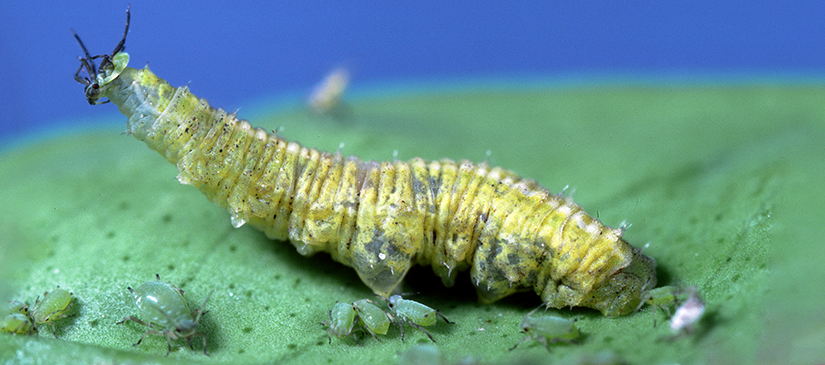
Recently an avocado grower in Fillmore sent me a photo of a wrinkled maggot-like larvae, followed by a large question mark. It looked just like a syrphid fly, what we commonly call a hoverfly or flower fly. But this fly maggot was a bright, colorful orange, not the green syrphid larvae I am accustomed to seeing. After consulting with my colleagues, I learned that syrphids actually come in a dramatic range of colors and shapes. I was excited to learn that there are over 6,000 species of these flies worldwide. There are about 300 species in California (where I’m from) including multiple species in the genera Allograpta, Metasyrphus, Paragus, Scaeva, Sphaerophoria, Syrphus, and Toxomerus. After delving into the ecology, behavior, and importance of syrphids, I’ve come to believe they are an underappreciated workhorse in citrus, avocado, and other crops. Syrphid flies not only pollinate flowers, but they also play an outsized role in biological pest control, even combatting the Asian citrus psyllid (ACP).
First, a little about the syrphid life cycle. These flies are remarkably adaptable to different conditions, and they inhabit diverse environments, including agricultural fields, grasslands, local parks, and urban gardens. Syrphids have four life stages: egg, larva, pupa, and adult. After hatching from an egg, larvae will develop through three instar stages. They then pupate on host plants or on the ground. Pupae generally require damp, humid environments to mature into adults, and likely benefit from litter, mulch, and biodiverse topsoils. The syrphid life cycle, from egg to adult, takes commonly 2-4 weeks, depending on the weather. They have 5 to 7 generations per year and are present throughout the growing season. The syrphid fly larvae vary in size from 4 to 18 mm in length, and can be green, white, brown, orange or yellow. Adult flies vary in length from to 3 to 13 mm, depending on the species. They have brown or black bodies and are marked with bright colored yellow and white stripes and spots that cover the abdomen and thorax. Because of this striping, they are sometimes mistaken for wasps or bees. This resemblance is a form of mimicry that syrphids have evolved to ward off predators. One tip for telling apart syrphids from bees is that syrphids have a single pair of wings, like all flies, whereas bees and wasps have two pairs of wings. Syprhids also tend to have shorter antennae and less hair than many bees.
Although we generally think of bees as our key pollinators, syrphid flies contribute significantly to pollination, visiting about 70% of food crop species and providing pollen transfer. Although an individual syrphid fly is unlikely to transport as much pollen as an individual bee, syrphids and other flies are so ubiquitous and abundant that en mass they play a crucial role in moving pollen between flowers. Some syrphid species also migrate over hundreds of miles by surfing on high altitude air currents, carrying pollen grains over distances which bees are not capable of flying. For some crops such as avocado, their efficiency as pollinators may rival that of bees –we just started a research trial this year to determine just exactly what their contribution to pollination is relative to honey bees.
Syrphids also play a role in controlling pests. Unlike adults, which feed on pollen and nectar, the larvael stage of many species feed on other insects, including aphids, caterpillars, thrips, mealybugs, leafhoppers, and other sap-feeding insects. Syrphid fly larvae are active year-round in Southern California, and each larvae can consume up to 400 aphids during development. When larvae are abundant, they have been shown to reduce aphid populations by up to 70% or more. Another notable example the syrphid fly’s role in pest control is its impact on the Asian citrus psyllid (ACP, Diaphorina citri), a notorious pest that poses a significant threat to citrus crops worldwide due to its ability to transmit citrus greening disease (Huanglongbing). Syrphid fly larvae are efficient predators of ACP nymphs, exerting significant mortality pressure on pest populations and reducing the spread of citrus greening disease. In the laboratory study by Dr. Mark Hoddle at UC Riverside, individual syrphid larvae consumed, on average, 421 ACP nymphs each. Syrphids, as part of an IPM program, help stem ACP outbreaks.
To attract syrphid flies, gardeners can provide them with flowers. However not all flowering resources benefit syrphids equally. UC Riverside research by Dr. Hoddle has shown that alyssum and buckwheat attract syrphids in high numbers. The small white flowers of alyssum and buckwheat are also attractive to other predators and parasitoids, making them excellent choices for insectary plantings for biological control.
Have you seen syrphid flies in your garden? What has been your experience with syrphids and pest control?
and phacelia!
I see a number of, and welcome, the syrphid flies in my garden every summer. They seem especially to love the tiniest flowers such as the alyssum you mentioned, as well as garlic chives, dill, etc. I have little trouble with aphids (just always the oleander aphids on milkweed spp.) but this late summer I noticed them for the first time on the undersides of my eggplant — and they were being tended diligently by ants. No harm was being done to the production of fruit, so I let things alone. I have found over many years that that’s usually best!
Thanks for the info – I’m so happy to know they’ll help the fruit farmers! We see lots of them in the nursery every summer, they like calamint and pycnanthemum too (who doesn’t?)