Friday quiz – please try again!

If you tried to post a comment/guess on the Friday quiz, you couldn’t…I gave the post the same name as a previous post, which somehow negates Sharepoint’s ability to accept comments.  Linda kindly renamed the post – so give it another try! 

(And Deb – no! Bwahahaha!)

Another lesson from my (eastcoast) garden

When we lived in Buffalo, we became warriors in the gypsy moth battle. One of the things we quickly learned was to check tree trunks for larvae, especially those trees with thick, rough bark where caterpillars could hide. It went without saying that burlap used to insulate tender plants came off as soon as possible in the spring, because that burlap was a great place for larvae to live as well.

Back in Washington state, we don’t have a gypsy moth infestation (yet), but the lesson was retained: we don’t leave materials wrapped around the trunks or branches of trees.… Continue reading this article “Another lesson from my (eastcoast) garden”

Friday Quiz from Holly!

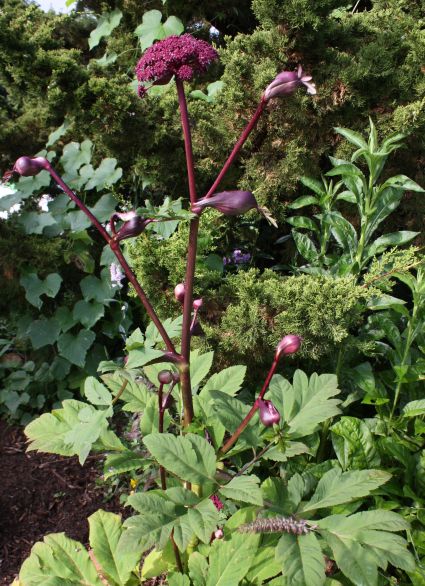
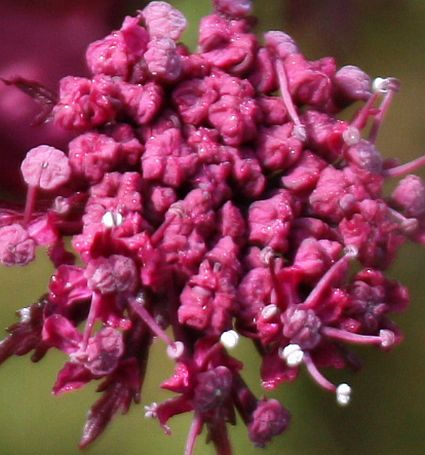
All right people…what is it?

*evil hand wringing and maniacal laughter*
[albeit quiet maniacal laughter, as not to disturb office mates]

Milky Spore

There are a lot of great products out there for controlling insect pests without using pesticides.  Some of the best include insect diseases or predators which will attack the pest and not beneficial.  For example, there are wasps that kill mealybugs and nematodes that attack grubs.  Both of these products are pretty effective.  That said there are also some products that just don’t work that well.  One of them is known as milky spore disease.… Continue reading this article “Milky Spore”

Plants aren’t so cooperative after all

One of the underlying tenets of ecology is the principle of competitive exclusion. This principle states that when two species compete for the same vital resource, the better adapted species will ultimately displace its competitor. Simply put, it’s survival of the fittest.

More recently, some ecologists have suggested that nature’s not quite so brutal – that the species composition in an ecosystem is determined more by random fluctuations in population numbers than by direct competition.

But last month, this "neutral theory" was directly challenged by evidence on three continents which compared the abundance of particular tree species, both in the fossil record and in existing forest ecosystems.… Continue reading this article “Plants aren’t so cooperative after all”

Why don’t landscape trees respond to fertilization?

As part of my ‘other duties as assigned’, I have taken on an assignment to develop fertilizer prescriptions for landscape trees and shrubs based on soil samples submitted by homeowners to the MSU soils lab.  This has gotten me immersed in two sets of conflicting literature. 

On one hand is a raft of extension bulletins and ISA guidelines on tree fertilization, which typically suggest adding 2-4 lbs of nitrogen (N) per 1,000 sq ft of ground area – in some cases up to 6 lbs of N per 1,000 sq ft (Rose 1999). … Continue reading this article “Why don’t landscape trees respond to fertilization?”

[Return of] National Forced Affection Day

After several incredibly informative posts from Jeff, Bert, and Linda, I’m going to give you a break as I veer off into Useless-land.

I’ve written posts previously regarding how important Valentine’s Day is for floriculture, most obviously the cut flower growers and florists.  In past posts, I’ve suggested alternatives to the boring/overpriced/under-fragranced/outsourced bouquet of red roses that folks seem to gravitate to.   The National Retail Federation predicts record-breaking sales in excess of $17 billion this year; $1.8 billion will be spent on cut flowers.… Continue reading this article “[Return of] National Forced Affection Day”

Our visiting professor digs into tomato planting depth

With Ray’s recent photos of the peach, crabapple, and hydrangea planted too deeply, a discussion of tomato planting depth arose in the comments. I’ve seen the prolific adventitious roots start to form near the base of tomato plants, and I plant tomatoes to the cotyledon or deeper, but tomato planting depth not an area I have extensive research experience in. So I did a little literature search.

It seems that the practice of planting tomatoes is more than just friendly garden folklore.… Continue reading this article “Our visiting professor digs into tomato planting depth”

Mulch: Just Do It

A follow-up to Linda’s post about a recent study in Arboriculture and Urban Forestry that indicated mulch may not reduce evaporation of water from soil as we generally assume and which suggested that landscapers may want to re-evaluate their mulching practices.  As Linda noted, we have some real concerns about this conclusion and believe that proper mulching of landscape trees and shrubs has well-established benefits.

First, I don’t question the results present in AUF article.  As my grad students frequently hear me say, the data are the data. … Continue reading this article “Mulch: Just Do It”

Stupid plant tricks

Blog reader Ray sent these photos of his weeping peach, weeping crabapple, and a Hydrangea paniculata, along with this comment:


“When a tomato grower extrapolates his applied knowledge to his landscape, before learning otherwise.”

(Translation for those tomato avoiders like me:  they are all planted too deeply, which tomatoes like.  Trees and shrubs, not so much.)