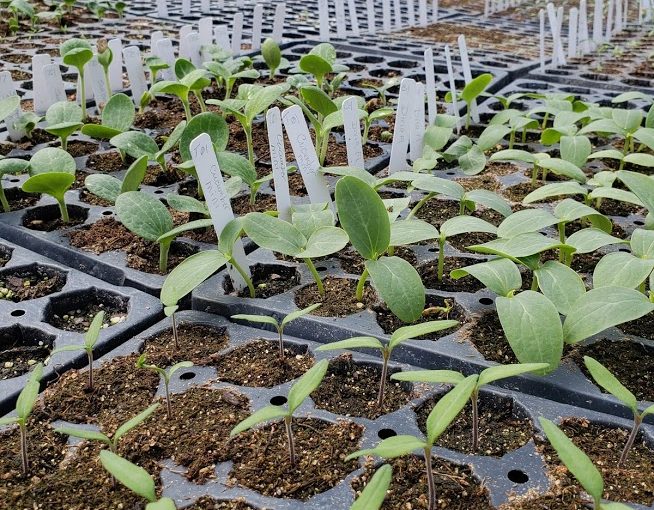
Feel the Heat: Temperature and Germination


In most parts of the country it is time to dust off the seed starting trays, pick out your favorite seeds, and get a little plant propagation going on.  There’s definitely a lot of science (and perhaps a bit of art) to successful seed starting.  While the process starts (and relies on) the imbibition of water, one of the biggest factors that affects the success, efficiency, and speed of seed germination and propagation is temperature. … Continue reading this article “Feel the Heat: Temperature and Germination”

Understanding mysteries of plant diseases: Diagnosis and Detection (Part 2 of 3 in this blog series)

Something is wrong?

Do you ever have a feeling that there is something wrong with a plant? It’s just not healthy looking, or it has not grown for awhile? As we discussed in the last blog, disease is a process–it occurs over time. When in the disease time-line you notice the process, can be quite varied. Some astute gardeners may know something is wrong before there are symptoms, others may not take notice of the process until the plant is dead.… Continue reading this article “Understanding mysteries of plant diseases: Diagnosis and Detection (Part 2 of 3 in this blog series)”

A Gardener’s Primer to Cold Hardiness, Part 2

Last week I discussed the mechanics of how cold hardy plants can survive temperatures far below freezing. Today we’ll consider the practical implications of this phenomenon and what, if anything, you can do to help your plants through cold snaps.

What happens when temperatures change at unusually high rates?

Remember, supercooling occurs when temperatures drop slowly, allowing water to leave living cells and freeze in the dead spaces between cells. When rates drop quickly, which can happen on sunny winter days once the sun goes down, water can freeze inside the cells before it has time to migrate into the extracellular space.… Continue reading this article “A Gardener’s Primer to Cold Hardiness, Part 2”

A Gardener’s Primer to Cold Hardiness, Part 1

With record low temperatures in some parts of the country, gardeners are understandably worried about the ability of their perennial and woody plants to survive the cold. What today’s post will do is give you some context for understanding how plants can survive temperatures far below freezing.

Why ice floats and how this damages cells

Everyone knows that ice floats, whether it’s an iceberg in the ocean or cubes in your favorite chilled beverage. Ice is lighter than water because its molecular structure is different: there is more space between water molecules in ice.… Continue reading this article “A Gardener’s Primer to Cold Hardiness, Part 1”