Here’s a photo of some pampas grass (Cortaderia selloana), much beloved by many homeowners in their landscapes:
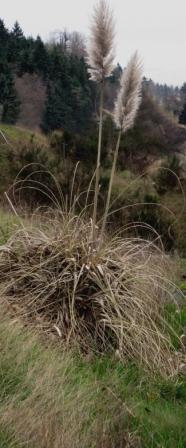
But what’s unusual – and undesirable – about this particular specimen? Hint: the landscape has been modified a little.
Answer on Monday!
Here’s a photo of some pampas grass (Cortaderia selloana), much beloved by many homeowners in their landscapes:
But what’s unusual – and undesirable – about this particular specimen? Hint: the landscape has been modified a little.
Answer on Monday!
Wow, we had some very creative answers on this one – and all of them made sense! Peter, however, was spot on with his identification of roots (of a Thanksgiving cactus) growing in water (in an antique graduated cylinder). I made it tricker by turning the photo upside down on Friday. Here it is right side up:

What I love about this photo is that the various parts of actively growing roots are clear (more or less): starting from the bottom you can begin to see the root tip and the hairless zone of elongation, followed by the zone of maturation with fuzzy root hairs, followed at the top by the area where lateral roots develop.</d
I had a few weeks’ hiatus while scrambling around for the holidays – but have one last teaser for you before the close of 2010. This photo is reminiscent of what Christmas trees will start looking like in the next few weeks. Can you figure out what it is?
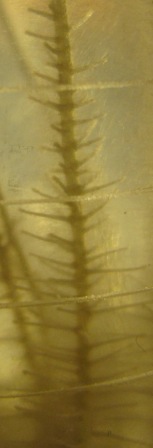
Ignore the parallel horizontal lines – they will be explained on Monday. And yes, the photo quality’s not great, but the reason for that will be clear on Monday as well.… Continue reading this article “Last puzzle of 2010”
Another easy one, or else you guys are just too smart! It is indeed a mistletoe. Gold stars to KB, John, Kandi, and Deb, and an extra point to Jane for identifying the genus (Phoradendron). I believe it’s Phoradendron bolleanum, an introduced species which parasitizes Cupressus arizonica (Arizona cypress).

In any case, I chose this puzzle plant in keeping with the holiday season! Thanks for playing!
Yet another "what am I?" post for Friday. Any takers on this one?

Have a nice weekend – answer on Monday!
I knew this one was pretty easy, but I have my reasons (below). Gold stars to KB, Jim, John, and Dave for correctly identifying rolls of sod (and they do seem thin, Peter):
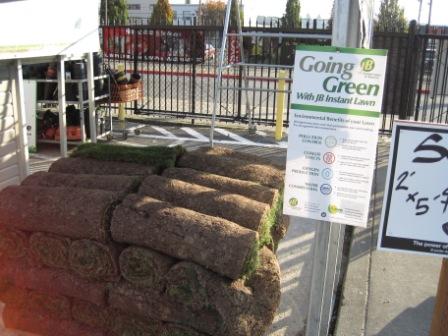
Yes, sod. I dislike instant lawns; they never look good for very long, at least in my part of the country. And getting rid of sod (as we have in our landscape) is a nightmare with that *%&$^ plastic mesh in which the grass is embedded. … Continue reading this article “Friday puzzle unrolled”
Here’s an early holiday gift – a stack of yummy beef and alfalfa sprout wraps:
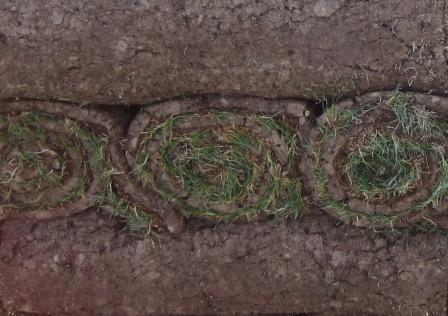
Or is it?
Answer Monday!
Wow, what a bunch of great guesses this week! All of them are logicial…but only Deb guessed it was a Christmas cactus (actually a Thanksgiving cactus – Schlumbergera truncata) :
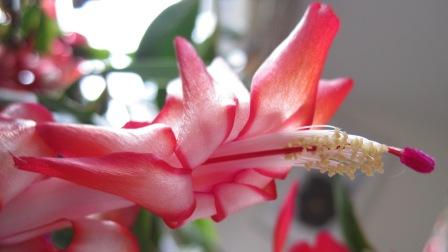
In any case, I thought this was a festive way to start the holiday season. (And please, no catty comments about my obsession with plant private parts.)
In keeping with the upcoming holiday season, enjoy this floral candy cane:

What is it?
Answer and another photo on Monday!
Good guesses over the weekend on what caused the twisty looking trunk structure in Friday’s puzzle. Here’s a larger photo:
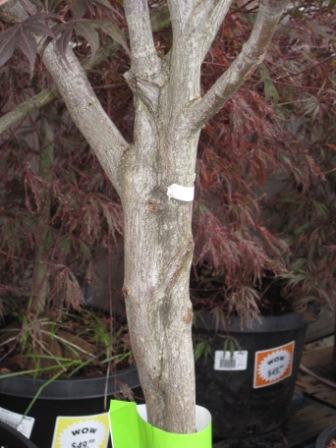
Nancy and Paul both got this one – it’s two trunks fused together. I have no idea whether the production nursery grew two saplings together on purpose or accidentally, but here’s one reason that this tree might be a problem down the road:
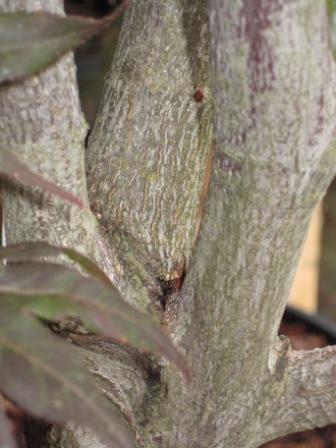
This area is ripe for disease, as water will collect in the crotch. … Continue reading this article “Trunk teaser untwisted”